


You may be paying rent, utilities and minimum credit card payments every month, yet the balances never seem to fall. A car repair goes onto a line of credit, groceries cost more than expected and little remains before payday.
Budgeting is more than tracking receipts. A realistic plan protects essential payments, creates room for debt repayment and savings and helps you assess whether a future loan, mortgage, or credit card payment is genuinely affordable.
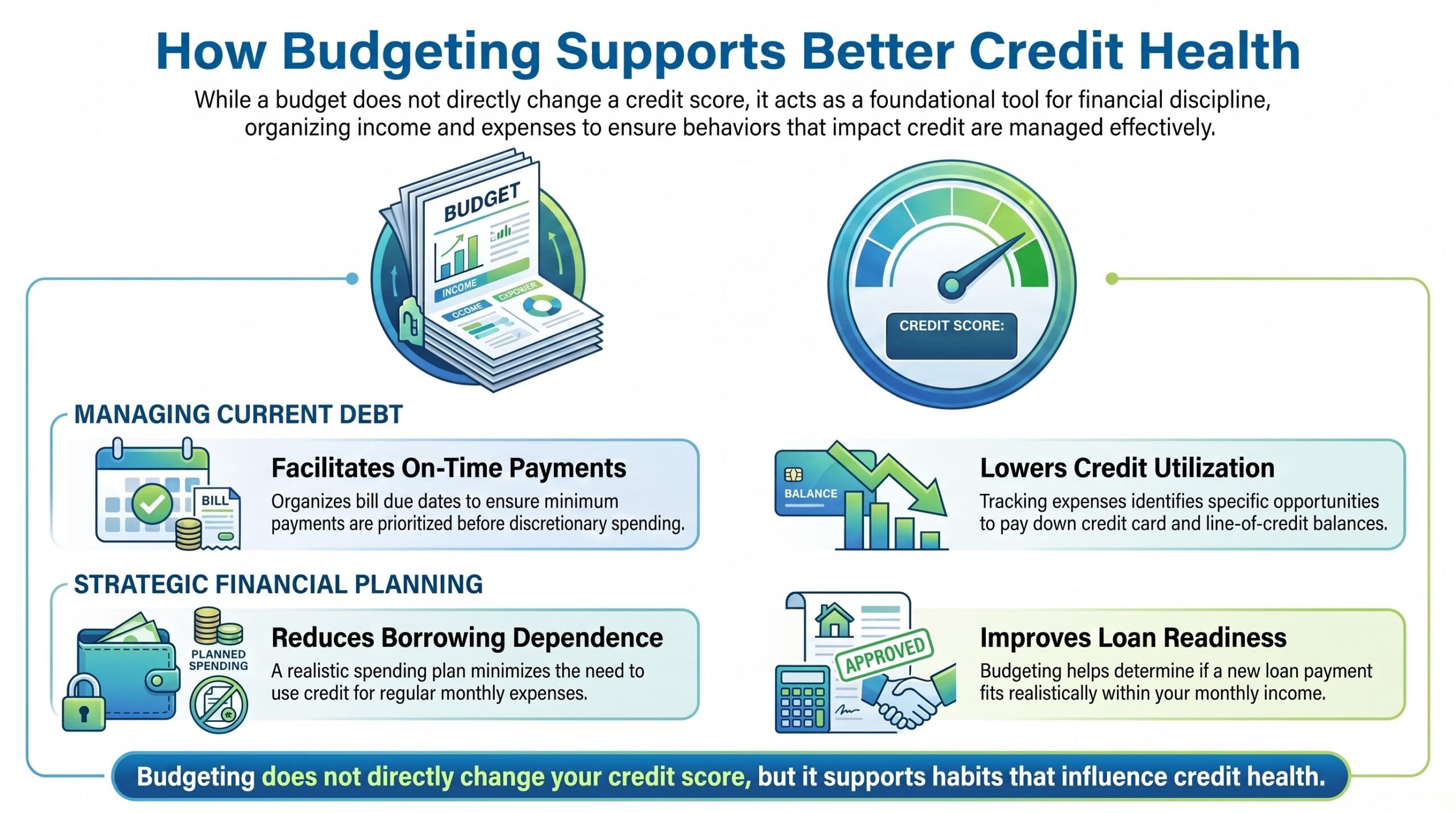
A budget does not directly increase a credit score. However, it can support the behaviours that influence credit health: paying obligations on time, keeping revolving balances manageable, avoiding missed payments and reducing dependence on new borrowing. The Financial Consumer Agency of Canada, or FCAC, describes budgeting as a way to compare income, savings and expenses while considering needs, wants, spending habits and financial goals.
Key Takeaways
- Build your budget from actual statements, not estimates.
- Protect essential expenses and minimum payments first.
- Allocate money for irregular costs such as repairs and annual fees.
- Use a genuine surplus for emergency savings and targeted debt repayment.
- Review the plan monthly and seek guidance when the numbers remain negative.
What Is Budgeting?
A Simple Budgeting Definition
Budgeting is deciding how available income will be used. A complete monthly plan includes net income, essential expenses, flexible spending, minimum payments, additional debt reduction, savings and irregular costs.
Several related financial tools serve different purposes:
- A budget is your forward-looking financial plan.
- Expense tracking records what has already happened.
- Cash-flow planning matches income dates with payment due dates.
- A debt repayment plan determines how balances will be reduced.
What a Realistic Budget Should Accomplish
A useful budget covers essentials first, prevents overlooked due dates and reveals whether a household has a monthly surplus or deficit. It should set clear priorities without becoming impossible to maintain.
Canadians who need more structured support can also explore Credit720’s budgeting guidance.
How Budgeting Can Affect Your Credit and Borrowing Opportunities
Budgeting and Payment History
Credit reports reflect whether financial obligations are paid as agreed. FCAC states that paying bills on time can support a credit score, while missed payments, high debt, collection activity and frequent credit applications can work against it.
Use a bill calendar, automatic reminders, or scheduled payments to reduce accidental lateness. Protect minimum payments before lower-priority spending and contact creditors before the due date when payment difficulty is expected.
Budgeting and Credit Utilization
Credit utilization is the amount of revolving credit you use compared with your available credit limits. For example, a $1,500 balance across cards with total limits of $5,000 represents 30% utilization.
FCAC recommends trying to use less than 30% of total available credit. However, credit scores can vary because lenders and credit bureaus may use different information, scoring models and approval criteria. Treat 30% as general guidance rather than a guaranteed score-improvement threshold.
A budget can free up money to reduce credit card and line-of-credit balances instead of repeatedly reusing available credit.
Budgeting and Loan Readiness
Lenders may consider your credit history, income, monthly obligations, recent applications and overall repayment capacity. Test any proposed payment after housing, food, transportation, insurance, taxes and existing debts have been covered.
Approval is not the same as affordability. Your budget should show whether a new payment can be maintained without sacrificing essential expenses or borrowing again.
How to Create a Monthly Budget in Seven Steps
Step 1 — Calculate Reliable Monthly Income
Start with net income—the amount actually deposited after payroll deductions. Include employment income, self-employment earnings, government benefits, pension income, support payments and side income only when it is reasonably dependable.
For irregular income, use a conservative average based on lower and typical earning months rather than your highest-income month.
Step 2 — Gather Financial Records
Review two or three months of:
- Bank statements
- Credit card statements
- Line-of-credit and loan statements
- Utility and insurance bills
- Pay stubs
- Subscription charges
Check both Equifax and TransUnion credit reports when confirming active accounts, balances and unfamiliar entries. Canadians can access their credit reports online for free from the country’s two main credit bureaus.
Step 3 — Separate Fixed, Variable and Irregular Expenses
Fixed expenses are usually predictable. Examples include rent or mortgage payments, insurance, loan payments, phone bills and internet service.
Variable expenses change from month to month. These may include groceries, fuel, utilities, transportation and personal spending.
Irregular expenses occur less frequently but must still be included. Examples include:
- Vehicle repairs and maintenance
- School costs
- Gifts and holiday expenses
- Annual memberships
- Property taxes
- Winter-related costs
- Insurance renewals
Divide annual and seasonal expenses by 12 and set aside the resulting monthly amount. A $1,200 annual insurance bill, for example, requires a $100 monthly allocation.
Step 4 — Distinguish Needs From Wants
Needs and wants differ between households. Protect housing, food, medication, basic utilities, required transportation, insurance and mandatory payments first.
Review optional categories without judgment. Sustainable reductions are generally more effective than eliminating every enjoyable expense. FCAC also recommends considering both needs and wants when developing a workable budget.
Step 5 — List Every Debt Payment
Create a debt table containing all relevant account information:
| Creditor | Debt type | Balance | Interest rate | Minimum payment | Due date | Status |
| Example Bank | Credit card | $4,200 | 19.99% | $130 | 18th | Current |
Include:
- Credit cards
- Personal loans
- Lines of credit
- Payday loans
- Buy-now-pay-later plans
- Tax and government debt
- Collection accounts
Mark whether each account is current, overdue, or subject to an existing payment arrangement.
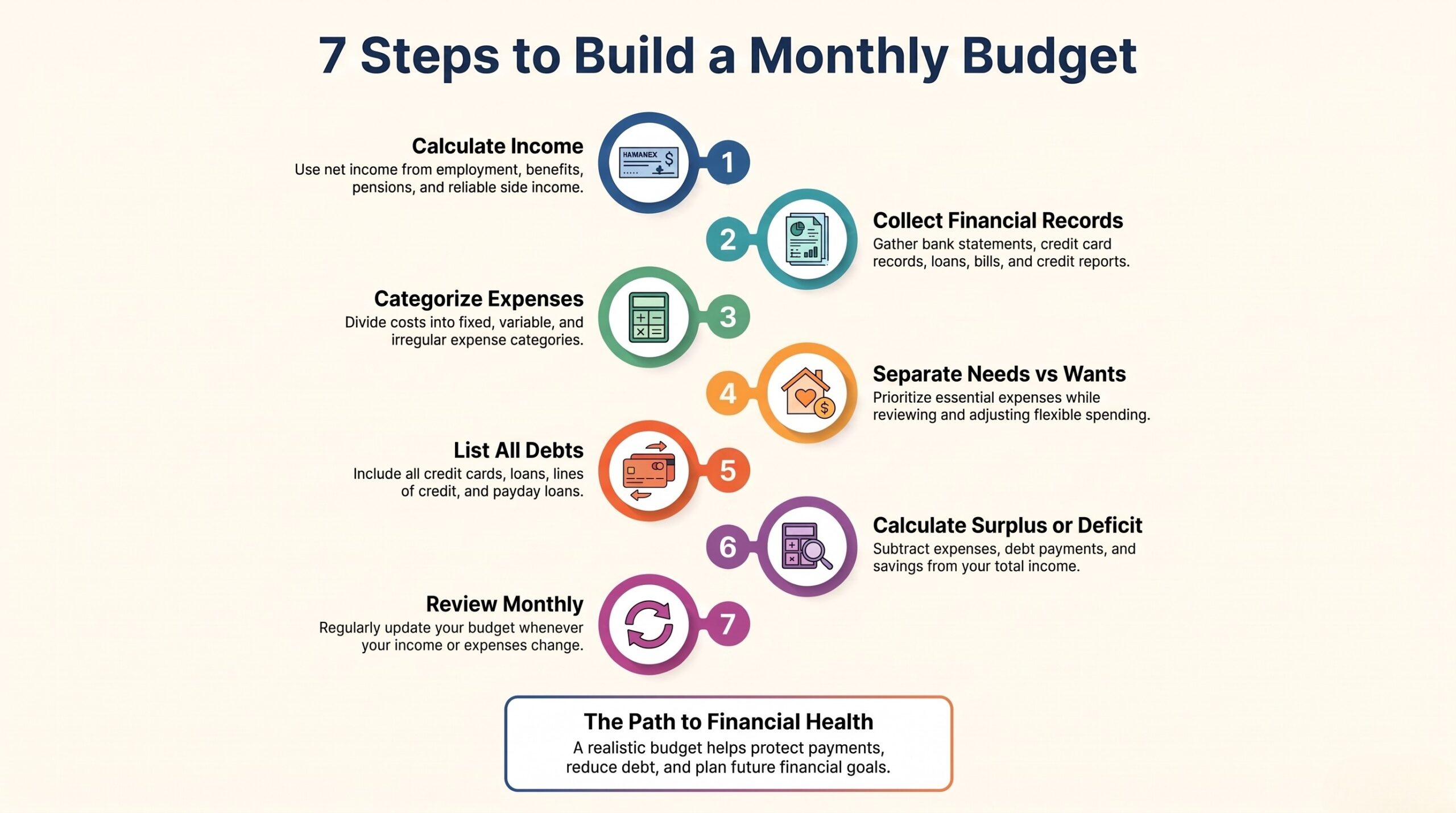
Step 6 — Calculate the Monthly Surplus or Deficit
Use the following formula:
Net monthly income − essential expenses − minimum debt payments − planned savings = monthly surplus or deficit
A surplus can be directed toward a priority debt, starter emergency savings, or an upcoming irregular expense.
A deficit means the current plan is financially unsustainable. Using new credit may delay the problem while adding interest charges, fees and another required payment.
Step 7 — Review and Adjust Every Month
Compare planned spending with actual transactions and adjust any limits that proved unrealistic.
Update your budget after changes involving:
- Income
- Rent or mortgage costs
- Childcare
- Insurance
- Transportation
- Debt payments
FCAC recommends reviewing actual spending against the budget and revising the plan when circumstances change.
Schedule a monthly money review on a consistent date so budgeting becomes a routine rather than a response to financial emergencies.
Which Budgeting Method Should You Use?
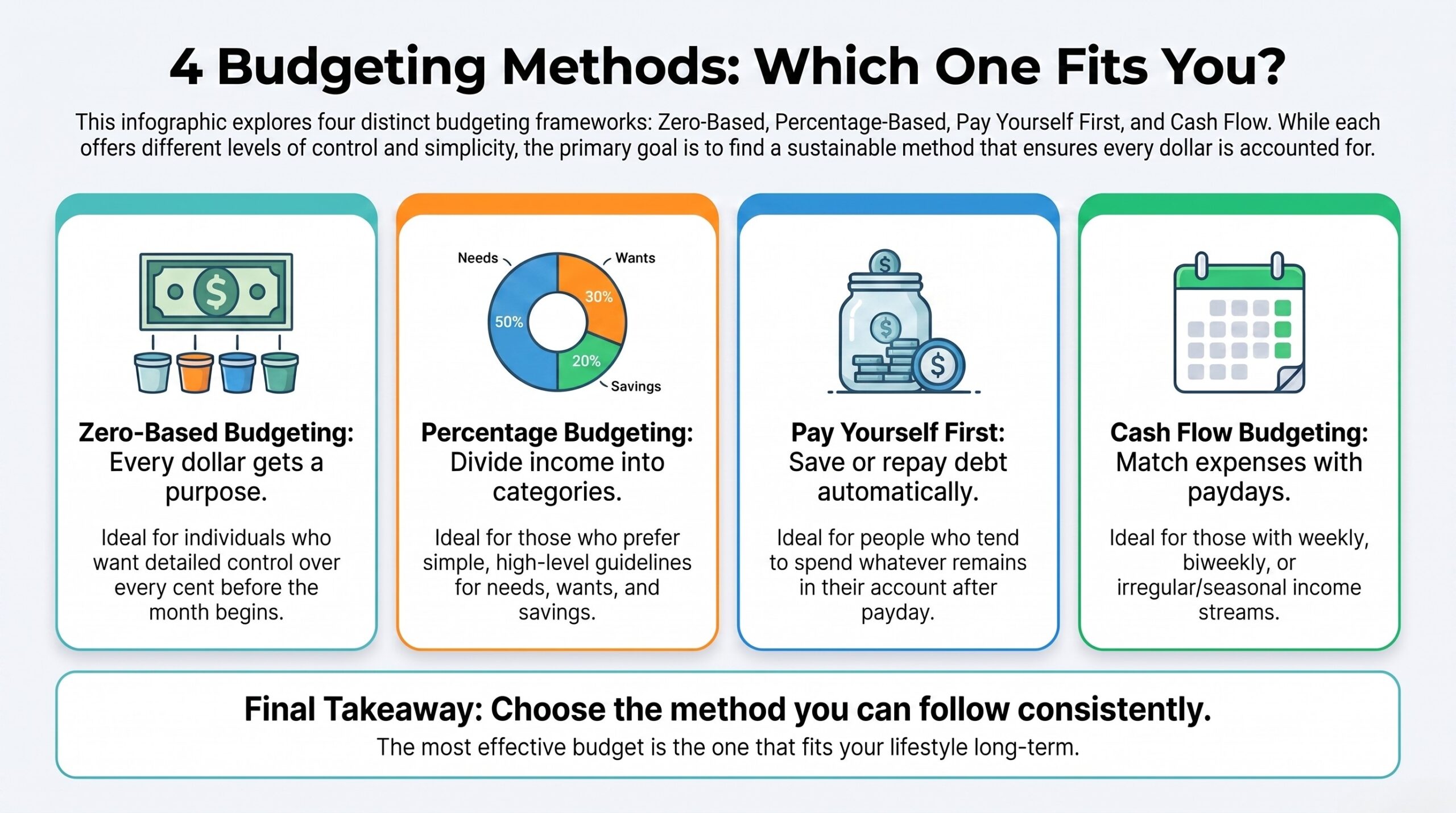
Zero-Based Budgeting
Give every dollar a specific purpose. “Zero” means all income is allocated to expenses, debt, savings, or financial goals—not that every dollar must be spent.
This approach can work well for households that need detailed control.
Percentage-Based Budgeting
Divide income among needs, wants, savings and debt. The popular 50/30/20 budgeting structure can be a starting point, but it is not a universal rule.
Canadians facing high housing costs, childcare expenses, or significant debt payments may need very different percentages.
Pay-Yourself-First Budgeting
Transfer money to savings or a priority debt immediately after payday. This method may help people who tend to spend whatever remains in their account.
Essential expenses and required payments must still be protected before transfers are automated.
Payday or Cash-Flow Budgeting
Organize expenses by weekly, biweekly, or irregular pay periods instead of using one calendar month. Match each bill to the paycheque that will cover it to reduce timing-related overdrafts and missed payments.
Expert tip: The best budgeting method is the one you can follow consistently, not the method that looks best on paper.
How to Budget When You Already Have Debt
Protect Essential Payments First
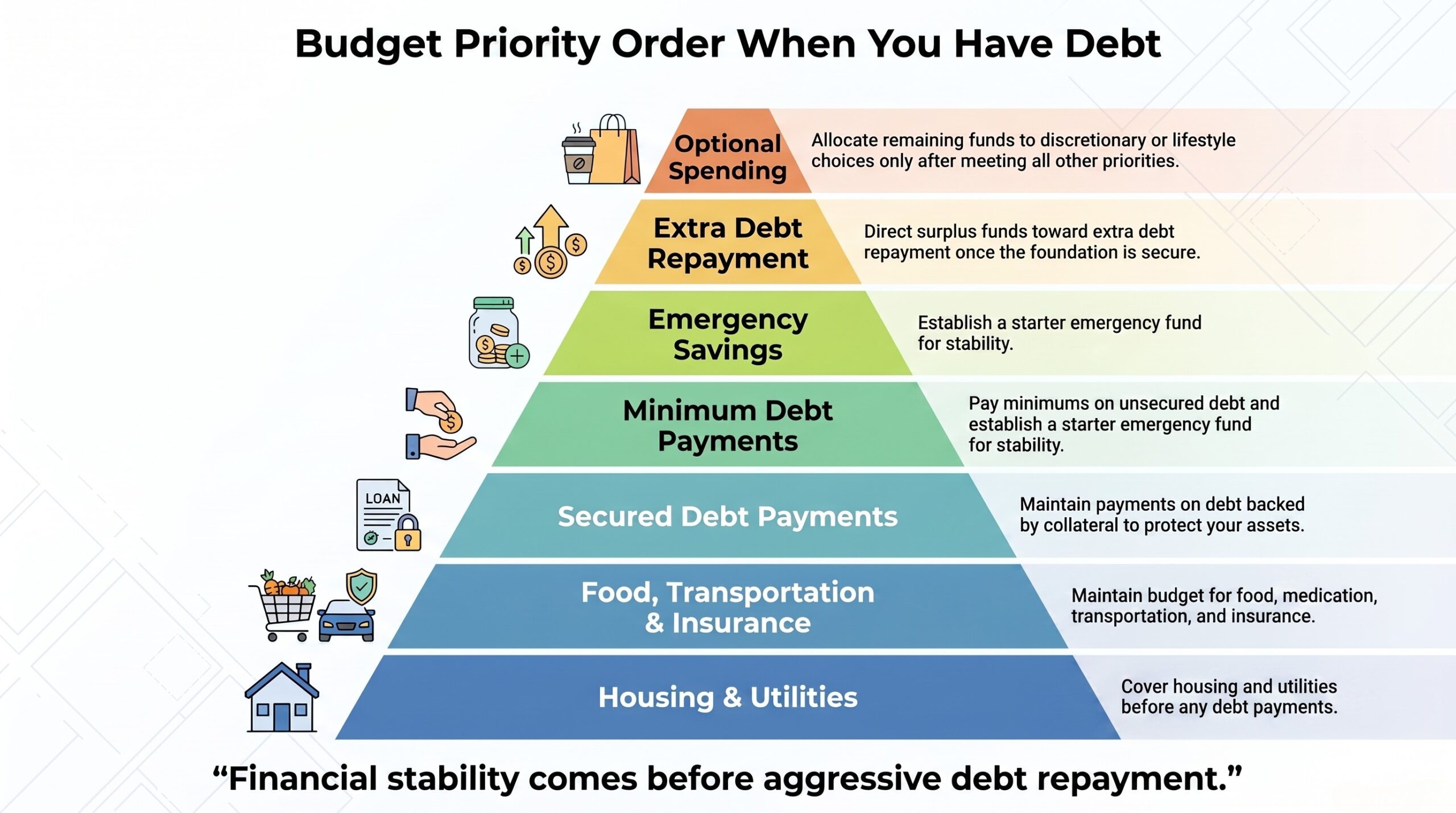
A practical payment order may be:
- Housing and essential utilities
- Food, medication, required transportation and insurance
- Required secured-debt payments
- Minimum unsecured-debt payments
- Starter emergency savings
- Additional targeted debt repayment
- Discretionary spending
Individual legal and financial circumstances may change this order.
Choose a Debt Repayment Strategy
The debt avalanche method sends extra money to the debt with the highest interest rate, usually reducing the total interest paid.
The debt snowball method targets the smallest balance first, creating faster account closures and visible progress.
A cash-flow approach targets a debt whose elimination will free a useful monthly payment. Continue making all required payments on every other account.
Budget for a Starter Emergency Fund
Even a modest reserve can keep an unexpected bill from returning to a credit card. FCAC recommends beginning with manageable contributions and gradually working toward approximately three to six months of regular expenses.
Building that full amount can take time. A starter fund of a few hundred dollars may still help cover smaller emergencies while debt repayment continues.
Know When Budgeting Alone May Not Be Enough
Consider professional guidance when:
- Minimum payments are unaffordable.
- Balances continue increasing after reasonable spending reductions.
- Credit is being used for groceries, rent, or utilities.
- Payments are repeatedly missed.
- Collection calls have started.
- One debt is being used to pay another.
- The household budget remains negative.
Credit720’s credit counselling service reviews income, expenses, debts, payment pressure and possible next steps rather than treating budgeting as a one-size-fits-all solution.
Common Budgeting Mistakes That Can Keep Canadians in Debt
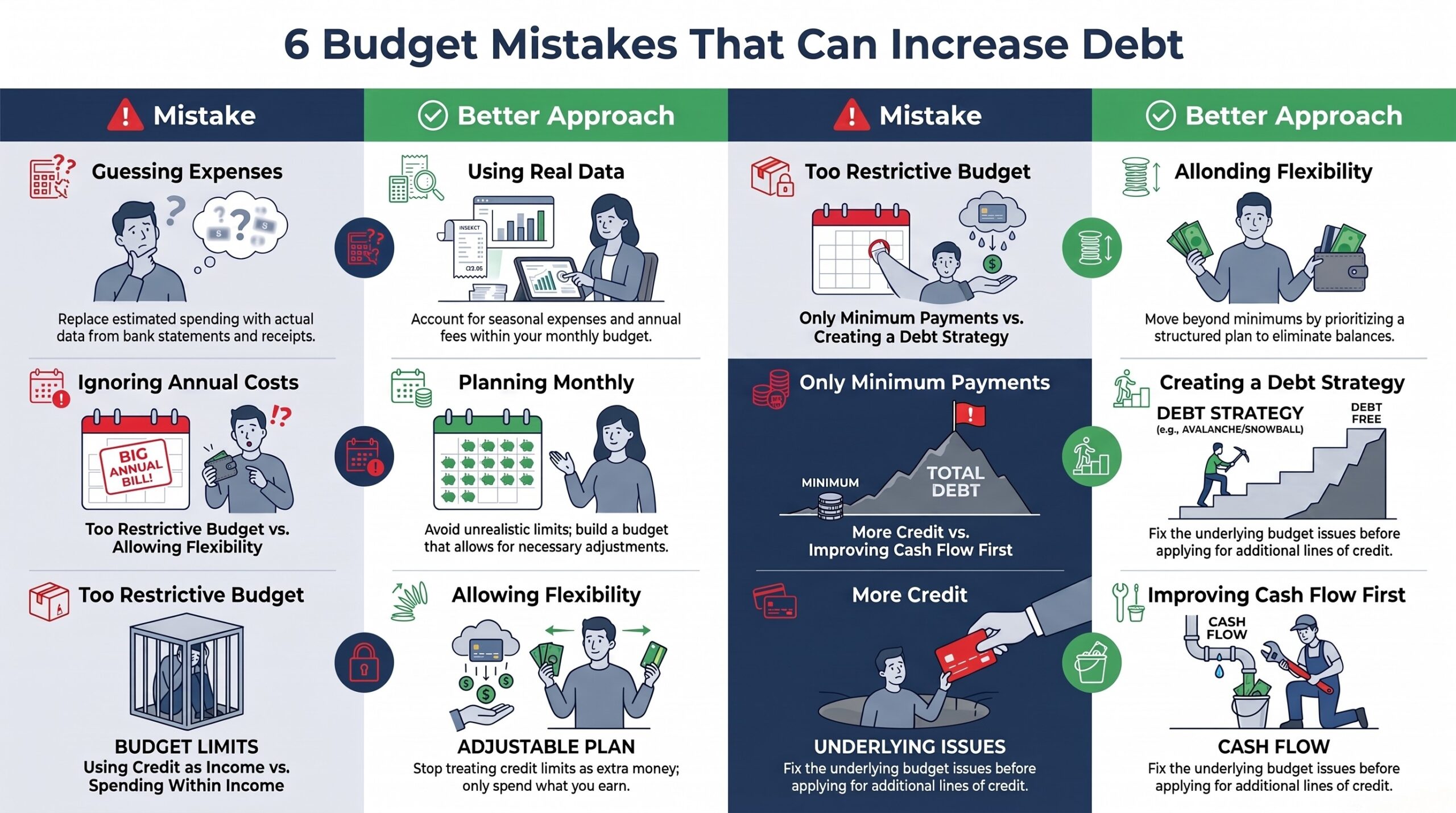
Building the Budget From Estimates
Memory often understates grocery spending, transportation costs, subscriptions and small recurring purchases. Use actual transaction records instead.
Forgetting Annual and Seasonal Expenses
Vehicle maintenance, school expenses, holidays, memberships, property taxes and insurance renewals should be included through monthly sinking funds.
Making the Budget Too Restrictive
A plan with no flexibility is difficult to sustain. Include a modest personal-spending category instead of removing every optional expense.
Treating Available Credit as Income
A credit limit is borrowed money, not additional household income. Using it to cover a recurring deficit increases future payment pressure.
Focusing Only on Minimum Payments
Minimum payments may keep an account current while extending repayment. On some lines of credit, interest-only payments do not reduce the amount originally borrowed.
Applying for New Credit Before Correcting Cash Flow
A consolidation loan may reorganize debt without correcting overspending or an income shortfall. Test the proposed payment against your budget before applying.
Budgeting Myths vs. Facts
| Myth | Fact |
| A budget means eliminating everything enjoyable. | A sustainable budget includes controlled discretionary spending. |
| Budgeting will immediately raise my credit score. | It supports timely payments and balance management, but results are not immediate or guaranteed. |
| I earn too little to budget. | Budgeting is especially important when every expense has a greater impact. |
| Carrying a credit card balance improves credit. | Responsible account use matters; paying interest is not required to build credit. |
| A consolidation loan automatically solves debt. | It may help only when the new payment is affordable and additional debt is avoided. |
| Checking my own credit report lowers my score. | Checking your own credit report or score does not affect your credit score. |
Practical Budget Example for a Canadian Household
Example Scenario
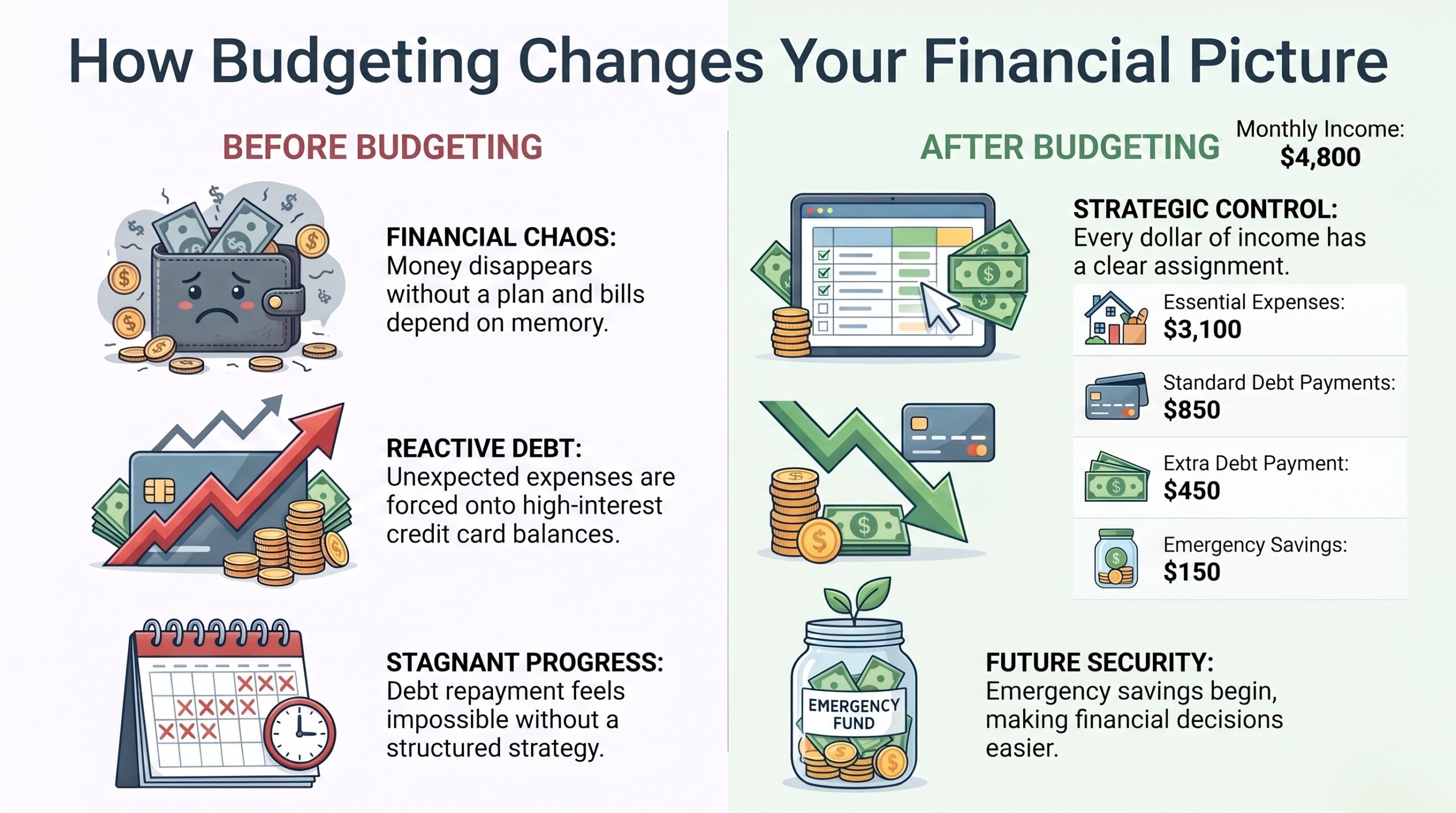
Consider this fictional household budget:
- Monthly net household income: $4,800
- Essential living expenses: $3,100
- Minimum debt payments: $850
- Irregular-expense allocation: $250
- Starter emergency savings: $150
- Additional debt repayment: $450
The household could automate minimum payments, direct the additional $450 toward one priority debt, reduce new credit card use and preserve the $150 emergency allocation.
Before vs. After Budgeting
| Before budgeting | After budgeting |
| Extra money disappears without a purpose. | $450 is assigned to one priority debt. |
| Repairs are placed on a credit card. | $150 builds an emergency reserve. |
| Payment dates rely on memory. | Minimum payments are automated. |
| Financial progress is unclear. | Balances and spending are reviewed monthly. |
After 30 days, the household should compare the plan with actual spending.
If the budget shows a deficit, it can reduce adjustable costs, review realistic income opportunities and contact creditors before missing payments. A professional debt review may be appropriate if the deficit remains.
How to Prepare Your Budget Before Applying for Credit
Calculate the Proposed Payment’s Real Impact
Add the estimated loan, mortgage, or credit card payment to the existing budget. Include related costs such as:
- Insurance
- Maintenance
- Property taxes
- Closing costs
- Annual fees
Confirm that the budget remains positive and can absorb at least a modest unexpected expense.
Review Your Credit Profile Before Applying
Check both credit reports for inaccurate balances, incorrect late-payment reporting, duplicate accounts, or unfamiliar activity. Review your credit utilization, existing obligations and recent applications before submitting another request for credit.
Avoid multiple unnecessary applications. The score you see may also differ from the score a lender uses because organizations can apply different models and assign different weight to information in your credit file.
When to Get Professional Budgeting or Debt Guidance
Professional help may be appropriate when the budget remains negative, balances do not decrease, payments are missed, or debt begins affecting essential living expenses. Guidance may also be useful when comparing debt consolidation, settlement, a consumer proposal, or bankruptcy.
A thorough financial review should examine:
- Household income
- Essential expenses
- Unsecured debt
- Interest rates
- Minimum payments
- Delinquent accounts
- Short- and long-term goals
Credit720 describes its approach as reviewing a person’s financial circumstances and considering budgeting, credit counselling, financing, or other debt options according to the individual situation.
Frequently Asked Questions
What Is the Best Way to Create a Monthly Budget in Canada?
Use net income and actual financial statements, separate fixed, variable and irregular costs, list every debt and calculate the monthly surplus or deficit. Review the plan every month rather than treating the first version as permanent.
Can Budgeting Help Improve My Credit Score?
Budgeting does not directly change a credit score. However, it can support on-time payments, lower revolving balances, fewer missed payments and fewer unnecessary credit applications. Results vary according to the individual credit file and scoring model.
Should I Save Money or Pay Off Debt First?
Protect essential expenses and minimum debt payments first. Then balance a starter emergency reserve with additional debt payments based on interest costs, income stability and expected expenses.
What Should I Do When Monthly Expenses Exceed My Income?
Confirm the deficit using actual statements, reduce adjustable costs, review income opportunities and contact creditors early. Avoid treating new borrowing as a permanent solution. Seek professional guidance when reasonable changes still leave the household budget negative.
Conclusion: Turn Your Budget Into a Monthly Financial System
A useful budget is realistic, measurable and updated regularly. It protects essential payments, reduces missed-payment risk, controls credit use and directs a genuine surplus toward debt reduction and savings.
Progress matters more than perfection. Review the plan monthly, adjust it as circumstances change and use the numbers before taking on new credit.
When debt payments leave little room in your monthly budget, Credit720 can help you review your financial situation and understand the options available. Book a Consultation to discuss a practical next step.