

When debt payments start taking over your monthly budget, it can become difficult to see a clear way forward. You may be paying one credit card with another, relying on payday loans for basic expenses, missing minimum payments, or dealing with collection calls while still trying to cover rent, groceries and utilities.
For Canadians in serious financial difficulty, bankruptcy is one possible debt-relief option. It is a formal legal process that can provide relief from many debts, but it can also affect your assets, credit report and ability to borrow in the future. Bankruptcy does not automatically mean losing everything, nor does it eliminate every kind of debt.
Before making a decision, it is important to understand bankruptcy alongside alternatives such as a consumer proposal, debt consolidation, credit counselling and budget restructuring.
This guide explains how bankruptcy works in Canada and what to consider before proceeding. It is educational information, not legal advice. Only a Licensed Insolvency Trustee can administer a Canadian bankruptcy or consumer proposal.
What Is Bankruptcy in Canada?
Bankruptcy Definition
Personal bankruptcy is a formal insolvency process available to people whose financial situation has reached the point where they cannot reasonably repay their debts.
Being in debt does not automatically mean being insolvent. Many Canadians carry mortgages, car loans or credit card balances while remaining capable of meeting their obligations.
Insolvency occurs when a person’s financial circumstances meet the requirements of Canada’s insolvency framework. Formally declaring bankruptcy goes a step further: it places the individual into a regulated legal process intended to provide financial relief while ensuring creditors are treated according to the Bankruptcy and Insolvency Act.
Bankruptcy is generally considered when more manageable repayment strategies are no longer realistic.
Who Handles Bankruptcy in Canada?
A Licensed Insolvency Trustee (LIT) is a federally regulated professional authorized to administer bankruptcies and consumer proposals.
This distinction matters. A debt advisor or credit counsellor may provide budgeting, debt-management or credit-rebuilding guidance, but only an LIT can administer a bankruptcy or consumer proposal.
Credit720 can help Canadians better understand debt affordability, credit recovery and available financial strategies, while an LIT must handle the formal insolvency proceeding itself.
When Might Someone Consider Bankruptcy?
Common Warning Signs of Serious Debt Problems
Financial difficulty becomes more serious when debt is no longer gradually decreasing despite regular efforts to manage it.
Signs that it may be time to review formal debt-relief options include:
- Regularly missing minimum payments
- Using one credit card or line of credit to pay another
- Keeping credit cards close to their limits
- Receiving collection calls or notices
- Facing wage garnishment or creditor legal action
- Depending repeatedly on payday loans
- Paying interest without meaningfully reducing principal
- Having little money left after essential living expenses
- Watching debt increase despite attempts to budget
A single warning sign does not mean bankruptcy is necessary. However, several occurring together may indicate that the current repayment strategy is unsustainable.
Bankruptcy Is Not Automatically the Best Solution
The appropriate debt solution depends on much more than the total amount owed.
Factors can include income, assets, household expenses, secured and unsecured debts, ability to make payments, employment stability, previous bankruptcies and whether alternative repayment arrangements remain affordable.
For that reason, compare several debt solutions rather than choosing bankruptcy simply because it appears to offer the lowest immediate monthly cost.
How Does Bankruptcy Work in Canada? Step-by-Step
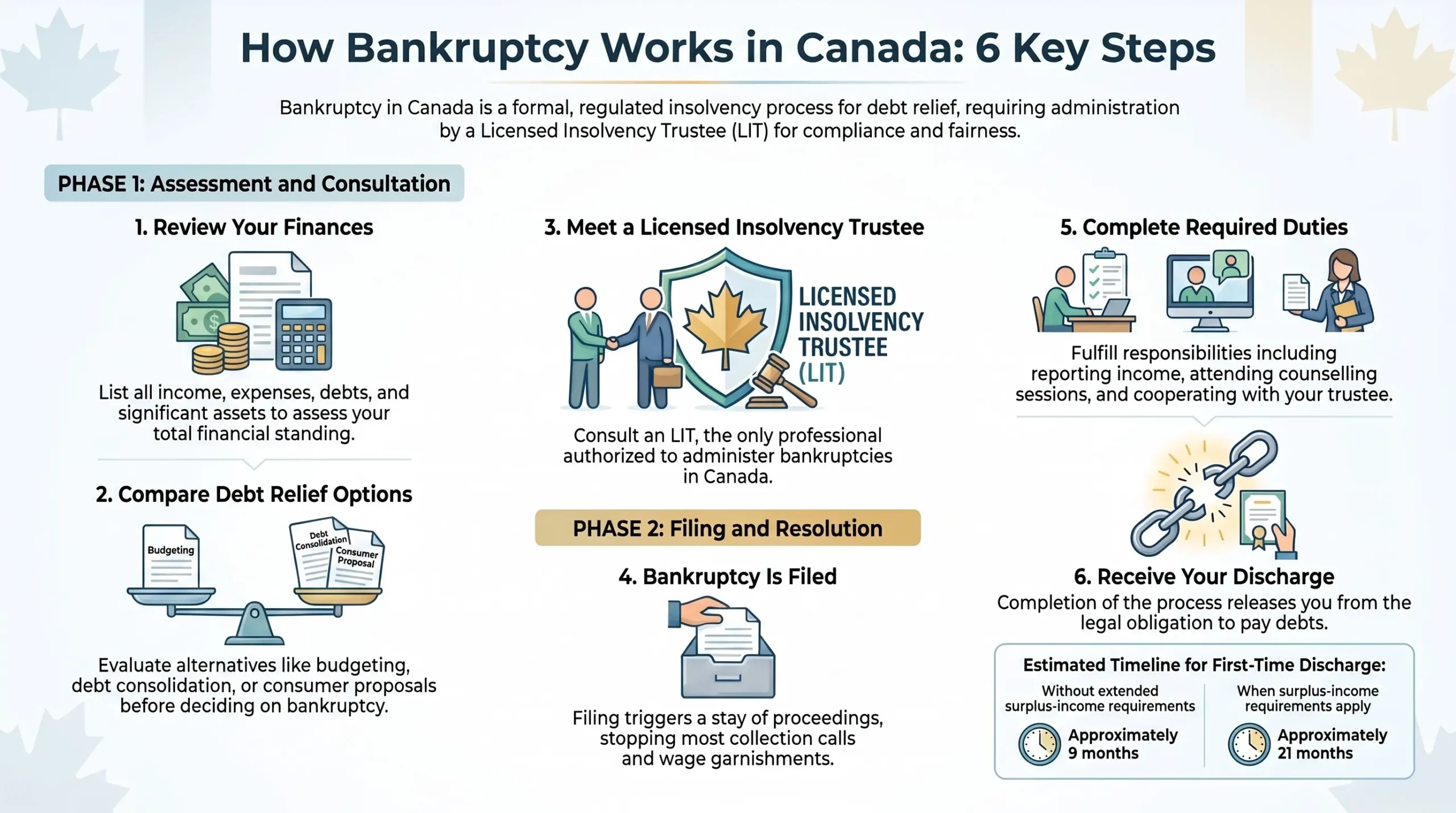
Step 1: Review Your Complete Financial Situation
Start with a complete financial inventory.
Record your income, regular expenses, credit cards, personal loans, lines of credit, payday loans, tax obligations, student loans, mortgages, vehicle financing and other debts. You should also identify significant assets.
Seeing the complete picture makes it easier to determine whether the primary problem is cash flow, high interest costs, excessive debt, income instability or a combination of issues.
Step 2: Compare Debt Relief Options
Before deciding to file bankruptcy, consider whether another strategy could realistically solve the problem.
Possible approaches include:
- Budget restructuring
- Debt consolidation
- Credit counselling
- A debt management plan
- A consumer proposal
- Bankruptcy
Debt consolidation, for example, may simplify payments and potentially reduce interest costs, but it does not automatically reduce the principal owed and still requires sufficient repayment capacity.
Step 3: Speak With a Licensed Insolvency Trustee
If bankruptcy or a consumer proposal may be appropriate, an LIT reviews your financial circumstances and explains the consequences of the available insolvency options.
Income, debts, expenses and assets are examined before bankruptcy documents are prepared if you decide to proceed.
Step 4: Bankruptcy Is Filed
Filing bankruptcy generally creates a stay of proceedings.
The stay stops most collection activity covered by the insolvency proceeding, including many collection calls, wage garnishments and ongoing legal recovery actions. Certain rights and exceptions can still apply, particularly to secured creditors.
Step 5: Complete Bankruptcy Duties
Depending on the case, duties can include reporting income, making required payments, supplying documents, providing tax information, cooperating with the trustee and completing required financial counselling sessions.
Step 6: Receive the Bankruptcy Discharge
For a first bankruptcy, a person may generally qualify for automatic discharge after nine months if surplus-income requirements do not extend the bankruptcy.
Where surplus-income requirements apply, a first bankruptcy may extend to 21 months. Longer periods can apply to subsequent bankruptcies or where discharge is opposed or required duties remain incomplete.
What Happens to Your Debts in Bankruptcy?
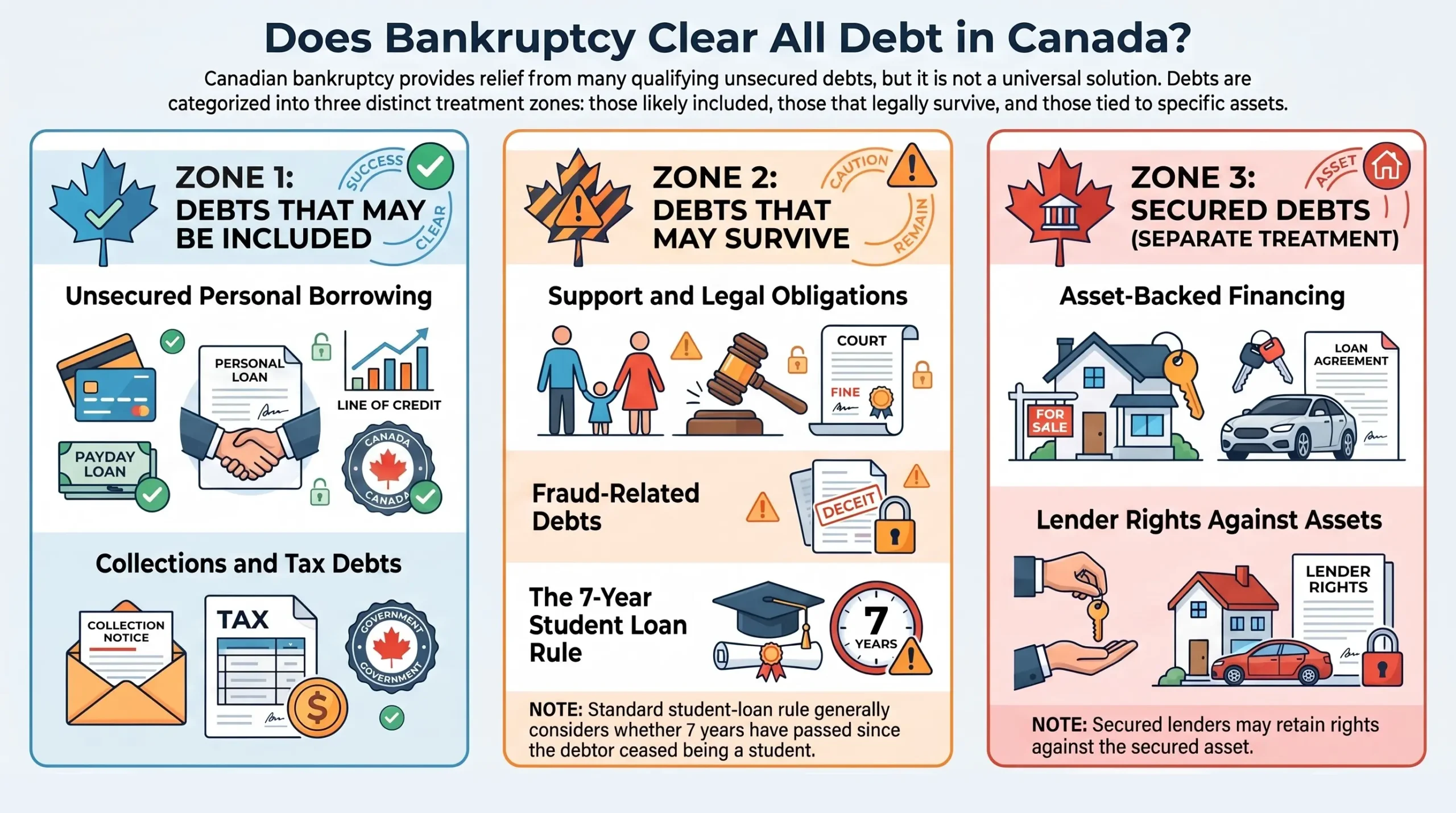
Debts That May Generally Be Included
Bankruptcy may deal with many unsecured debts, including qualifying:
- Credit card balances
- Unsecured personal loans
- Lines of credit
- Payday loans
- Collection accounts
- Certain tax debts
- Other unsecured obligations
The exact treatment depends on the nature of the debt and the circumstances. A discharge generally releases a bankrupt from claims provable in bankruptcy except for debts specifically excluded under the Bankruptcy and Insolvency Act.
Debts That May Survive Bankruptcy
Bankruptcy does not eliminate every financial obligation.
Examples of debts that may survive discharge include child or spousal support, certain court fines or restitution obligations, certain liabilities involving fraud and some student loan debt.
Canadian government student loans require particular attention. Under the standard rule, student loan obligations generally are not released if bankruptcy occurs within seven years after the individual ceased being a full- or part-time student. The Act also provides a hardship application mechanism in certain circumstances after five years.
What About Secured Debts?
Mortgages, financed vehicles and other secured debts need separate analysis because the lender has rights connected to the asset securing the loan.
Bankruptcy does not simply erase the lender’s security interest.
What Happens to Your House, Car, Savings and Other Assets?
Exempt vs Non-Exempt Assets
A common misconception is that declaring bankruptcy means surrendering everything you own.
In reality, certain property may be exempt from seizure. Provincial and territorial exemption rules play an important role, which means asset treatment can differ depending on where you live.
Home Equity
Homeowners require an individualized assessment.
Relevant factors include:
- Current property value
- Outstanding mortgage balance
- Available equity
- Provincial exemption rules
- Other claims secured against the property
Two homeowners with identical mortgages could therefore experience different outcomes because their equity and provincial rules differ.
Vehicles, RRSPs and Personal Property
Vehicle treatment can depend on its value, financing and applicable exemptions.
RRSPs generally receive protection under federal insolvency rules, subject to rules that can affect contributions made during the 12 months before bankruptcy.
Myth: Declaring bankruptcy means the government takes everything you own.
Fact: Asset treatment depends on the type and value of the property, financing arrangements and applicable exemption laws.
How Bankruptcy Affects Your Credit Score and Credit Report
Immediate Credit Impact
Bankruptcy is a serious negative event on a Canadian credit file. The exact number of credit-score points lost cannot be predicted because scoring formulas and individual credit histories differ.
An insolvency history, missed payments, collection accounts, existing balances and other credit behaviour can all influence a credit profile.
Immediately after bankruptcy, obtaining conventional credit may be more difficult, and available financing may come with less favourable terms.
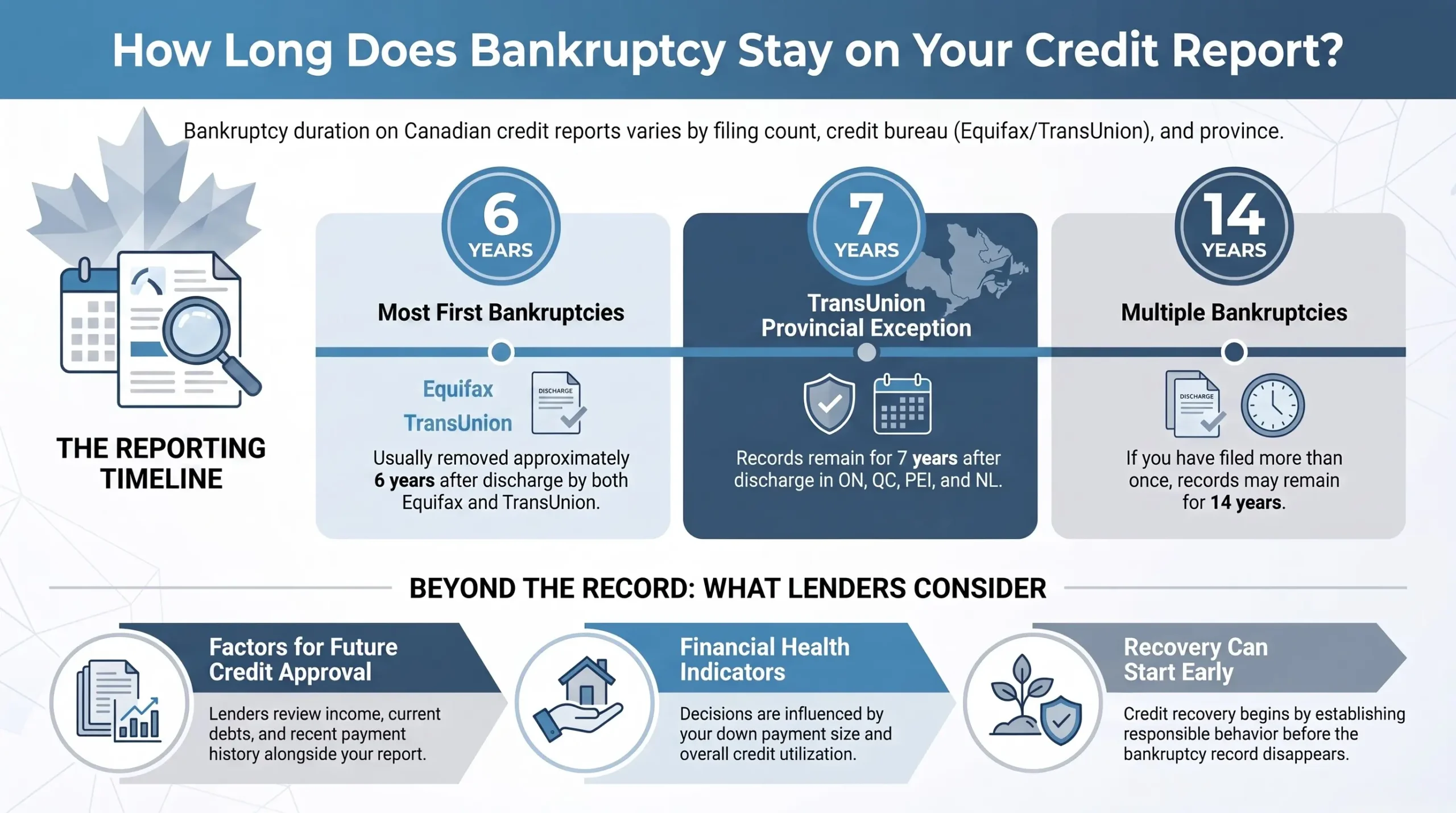
How Long Does Bankruptcy Stay on a Credit Report in Canada?
A first bankruptcy is usually removed from Canadian Equifax and TransUnion credit reports six years after discharge. TransUnion generally keeps it for seven years after discharge in Newfoundland and Labrador, Ontario, Prince Edward Island and Quebec. Multiple bankruptcies may remain on a credit report for 14 years.
This is why the frequently repeated statement that “bankruptcy stays on your credit report for seven years” is too broad for Canadian consumers.
How Bankruptcy May Affect Future Borrowing
Bankruptcy history can affect applications for:
- Credit cards
- Personal loans
- Vehicle financing
- Mortgages
- Rental housing
Lenders may consider your credit history when deciding whether to approve financing, how much to lend and what interest rate to charge.
Bankruptcy alone does not determine every future lending decision. Income, down payment, recent repayment behaviour, current debt and each lender’s underwriting requirements may also matter.
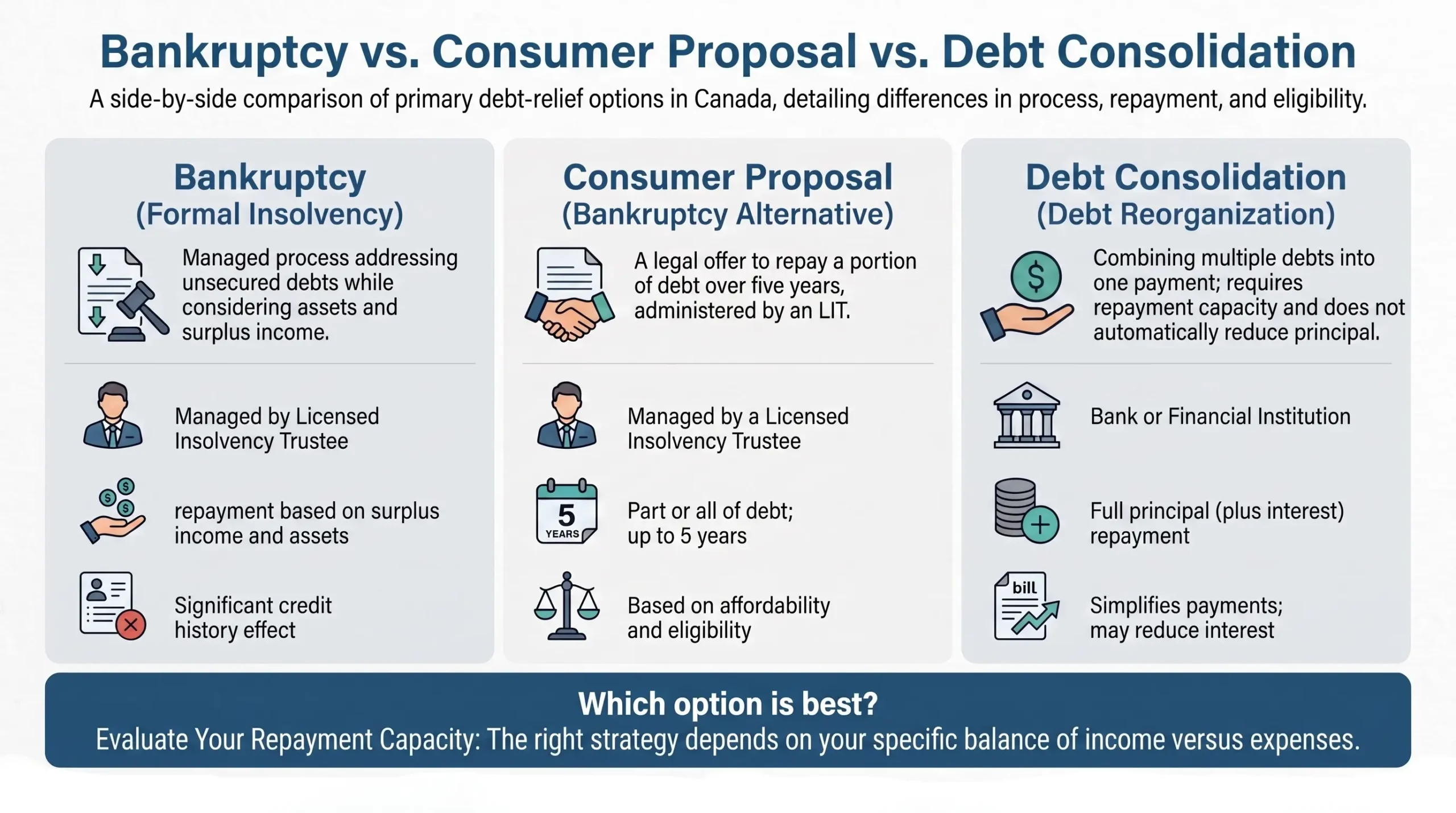
Bankruptcy vs Consumer Proposal vs Debt Consolidation
| Option | How It Works | Key Consideration |
| Bankruptcy | Formal insolvency process administered by an LIT | Assets, surplus income and significant credit impact must be considered |
| Consumer Proposal | Formal offer to repay some or all qualifying debt through an LIT | Payments can extend for up to five years |
| Debt Consolidation | Combines or reorganizes debts into fewer payments | Usually requires adequate income and borrowing eligibility |
| Credit Counselling | Budgeting support and potentially structured repayment | Participation and terms depend on creditors and the program |
A consumer proposal allows an eligible debtor to make an offer to creditors to repay all or part of qualifying debt over an agreed period. Canadian law limits the proposal term to five years.
Credit counselling can instead focus on budgeting, financial education and debt management. FCAC notes that credit counselling agencies may provide one-on-one counselling, financial education and debt management plans.
Is a Consumer Proposal Better Than Bankruptcy?
Neither option is universally better.
The appropriate solution depends on debt type and amount, income, assets, affordability and the individual’s broader financial circumstances. Comparing both options with other viable repayment strategies is more useful than assuming one solution is automatically superior.
How to Rebuild Credit After Bankruptcy
Bankruptcy can affect credit for years, but financial recovery does not have to wait until the bankruptcy disappears from your report.
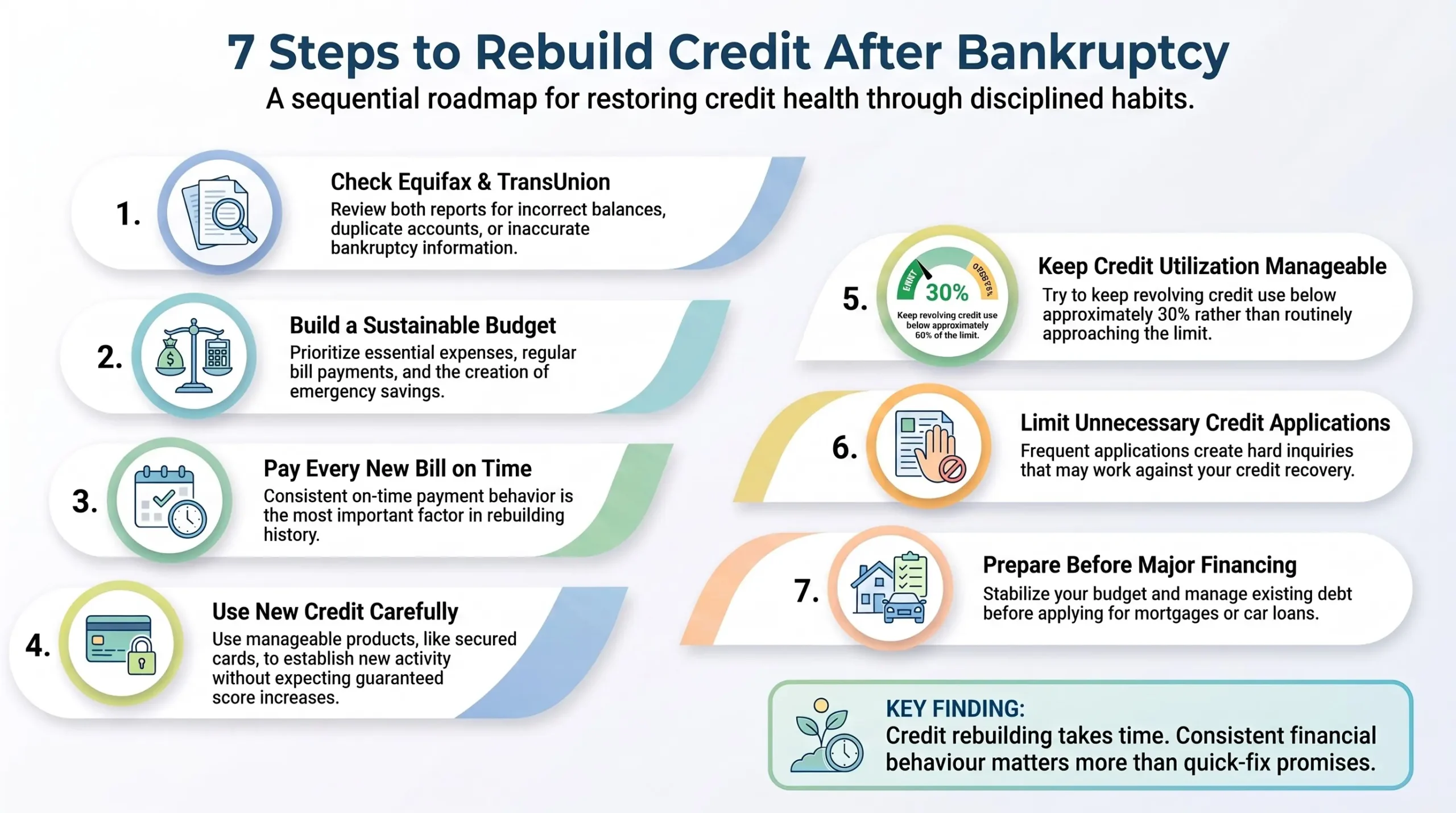
Step 1: Check Both Credit Reports
Canada has two main credit bureaus: Equifax and TransUnion. Consumers can access their credit reports online for free.
Review both reports for incorrect balances, personal-information errors, duplicate accounts or inaccurate reporting. Credit bureaus must investigate disputed errors and correct information they confirm is inaccurate.
Step 2: Build a Sustainable Budget
Create a budget that prioritizes essential living expenses, predictable payments and emergency savings.
The objective is to reduce the chance that an unexpected expense forces you back into expensive short-term borrowing.
Step 3: Never Miss New Payments
Payment history is a major factor in credit scoring. FCAC recommends making payments on time and contacting creditors early when you expect difficulty paying.
Step 4: Use New Credit Carefully
A secured credit card can be one option for people rebuilding after bankruptcy. These cards require a security deposit, and responsible use can contribute to rebuilding credit history.
No credit product, however, can guarantee a particular score increase.
Step 5: Keep Credit Utilization Manageable
Credit utilization measures how much revolving credit you use compared with the limits available to you.
FCAC recommends trying to use less than 30% of your total available credit rather than repeatedly approaching or exceeding your limits.
Step 6: Limit Unnecessary Credit Applications
Each new loan or credit-card application may create a hard inquiry. Too many applications close together can negatively affect your credit profile.
Step 7: Prepare Before Major Financing
Before applying for a mortgage, car loan or personal loan, review your credit reports, stabilize your budget and demonstrate consistent repayment behaviour.
Credit720’s credit-rebuilding guidance can help Canadians understand their credit position and develop realistic financial habits before pursuing larger borrowing decisions.
Common Bankruptcy Myths vs Facts
|
Myth |
Fact |
| Bankruptcy eliminates every debt. | Some obligations survive bankruptcy. |
| You lose everything you own. | Exemptions and asset treatment vary. |
| You can never qualify for credit again. | Credit rebuilding is possible, although it requires time and responsible behaviour. |
| Bankruptcy disappears when you are discharged. | The bankruptcy record generally remains on credit reports for years after discharge. |
| Bankruptcy is your only option once debt becomes overwhelming. | Proposals, consolidation, counselling and other strategies may also be available. |
These distinctions are important because bankruptcy should be evaluated based on your actual financial circumstances rather than common assumptions.
Common Mistakes to Avoid Before and After Bankruptcy
Choosing Bankruptcy Without Comparing Alternatives
Understand the financial, legal and credit implications before deciding.
Assuming Every Debt Will Disappear
Identify support obligations, student debt and other liabilities that could survive discharge.
Taking High-Cost Credit Immediately Afterward
Avoid solving a short-term cash-flow issue by recreating a high-interest debt cycle.
Applying for Too Much Credit Too Quickly
Rebuild gradually instead of submitting multiple applications in a short period.
Ignoring the Cause of the Original Debt
Consider whether the original problem came from overspending, income loss, insufficient savings, high-interest borrowing or unrealistic budgeting.
Falling for “Instant Credit Repair” Claims
Be cautious of anyone promising a rapid or guaranteed credit-score fix. FCAC specifically warns consumers about potentially misleading debt-help and credit-repair claims.
Practical Bankruptcy Example
Example — Canadian Household With Heavy Unsecured Debt
Imagine a household carrying $45,000 in unsecured debt, including several credit cards, a personal loan and an account in collections. Monthly income covers essential expenses but leaves little available for debt repayment, and the household’s credit profile has already deteriorated.
Several paths could be examined.
Path A: Budget restructuring or consolidation if full repayment remains realistically affordable.
Path B: A consumer proposal if full repayment is unrealistic but structured payments may be manageable.
Path C: Bankruptcy if the household cannot reasonably manage the debt through available alternatives.
The right solution depends on actual income, assets, debt composition and affordability—not the debt balance alone.
Expert Tips Before Making a Bankruptcy Decision
Before deciding, take time to:
- Obtain a complete list of debts and balances.
- Review both Equifax and TransUnion reports.
- Prepare a realistic monthly budget.
- Separate secured debts from unsecured debts.
- Determine which debts may survive bankruptcy.
- Compare bankruptcy with a consumer proposal and other options.
- Ask how each solution could affect assets and future borrowing.
- Avoid decisions based solely on advertisements promising fast debt relief or credit repair.
A structured financial review can make it easier to understand whether the real objective should be consolidation, negotiated repayment, formal insolvency or another solution.
Frequently Asked Questions
What happens when you declare bankruptcy in Canada?
A Licensed Insolvency Trustee administers the process, qualifying debts are addressed through the insolvency system, most covered collection activity stops, and you complete required duties before becoming eligible for discharge.
How long does bankruptcy stay on your credit report in Canada?
It is usually removed by Equifax and TransUnion six years after discharge. TransUnion uses seven years in Newfoundland and Labrador, Ontario, Prince Edward Island and Quebec.
Does bankruptcy clear all debt in Canada?
No. Certain debts, including support obligations, some court-related liabilities, certain fraud-related debts and qualifying student loans, may survive bankruptcy.
Is a consumer proposal better than bankruptcy?
Not automatically. A proposal may suit someone able to make structured payments, while bankruptcy may be considered where other repayment approaches are not realistic. Individual circumstances determine which approach is appropriate.
Does bankruptcy stop collection calls?
The stay of proceedings generally stops most collection calls and other covered collection actions after bankruptcy is filed, although exceptions can apply.
Can you get a mortgage after bankruptcy in Canada?
Bankruptcy does not permanently prevent someone from obtaining a mortgage. Future approval will depend on the lender’s criteria and the borrower’s subsequent credit history, income, debts, down payment and overall financial profile.
Final Conclusion
Bankruptcy can provide meaningful debt relief for some Canadians, but it is a significant financial decision rather than a quick fix. Understanding which debts may be discharged, what can happen to assets, how long bankruptcy affects a credit report and how future borrowing may change is essential before proceeding.
Just as importantly, bankruptcy should be compared with alternatives such as consumer proposals, debt consolidation, credit counselling and budget restructuring.
Financial recovery ultimately depends on solving both the immediate debt problem and the circumstances that contributed to it. If debt is becoming difficult to manage, Credit720 can help you review your financial position, understand available debt-management options and develop a practical path toward stronger credit and long-term financial stability.