


Access to financing can make the difference between delaying an important business decision and moving forward with confidence. A Canadian business owner might need money to purchase equipment, build inventory, manage seasonal expenses, hire employees or expand into a new location. The challenge is figuring out which financing option fits the business without creating more financial pressure.
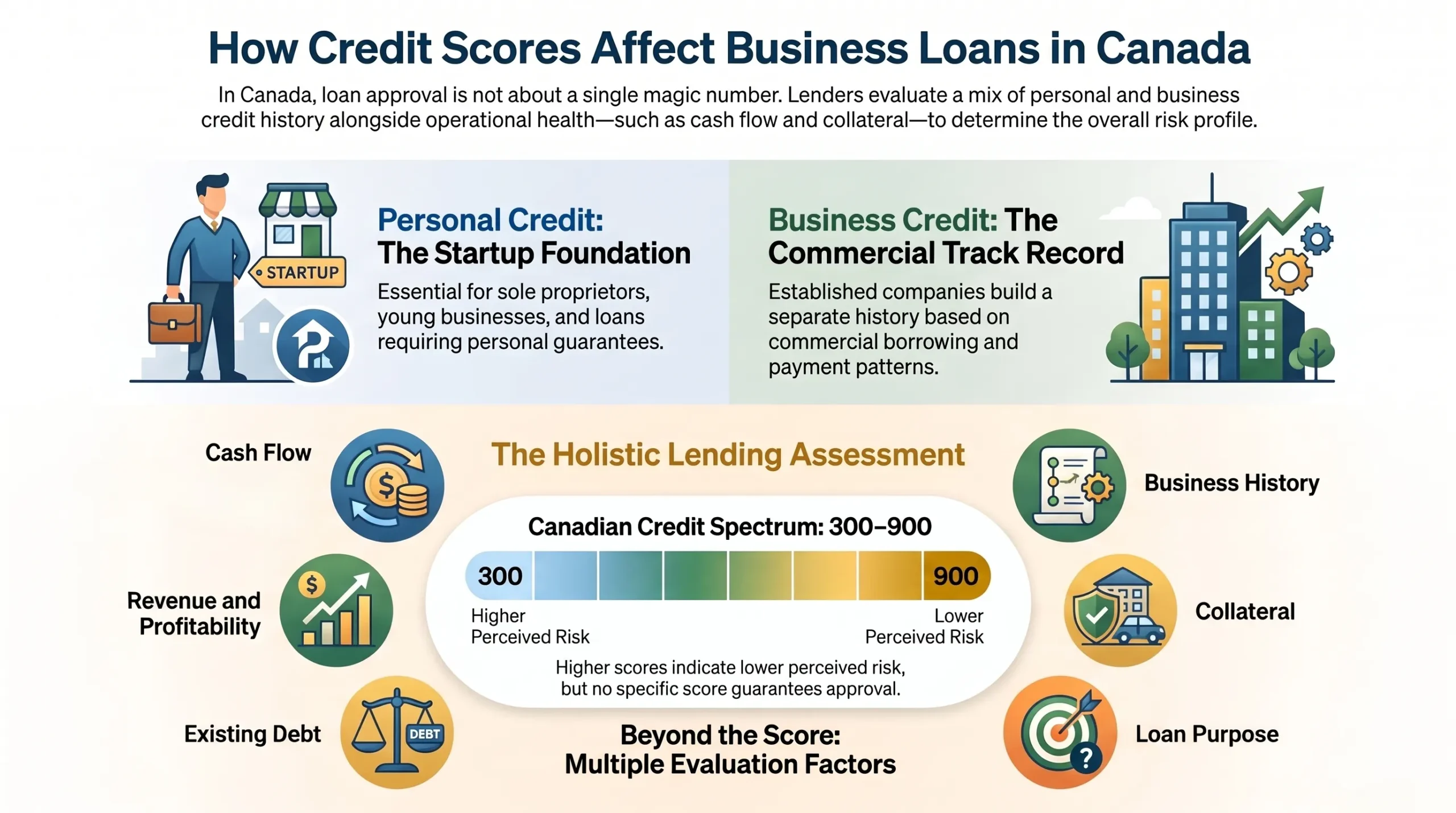
Business loans in Canada are not approved based on one number alone. Depending on the lender and financing product, factors such as personal credit history, business credit, revenue, cash flow, existing debt, collateral, operating history and the purpose of the loan may all influence the decision.
Even business owners with less-than-perfect credit may have options, although borrowing costs and approval requirements can differ.
This guide explains how business financing works in Canada, what lenders look for, how credit scores may affect an application, how to apply and when taking on additional debt may not be the best financial move.
Key Takeaways
- There is no single minimum credit score required for every business loan in Canada.
- Lenders typically consider credit alongside cash flow, profitability, debt and business history.
- Term loans, lines of credit, equipment financing and government-supported financing serve different purposes.
- Bad credit does not automatically eliminate every financing option.
- The total cost of borrowing matters more than the monthly payment alone.
- Business owners should understand existing personal and business debts before adding another financial obligation.
What Is a Business Loan and How Does It Work in Canada?
Business Loan Definition
A business loan is money borrowed for an eligible business purpose and repaid under agreed terms.
The amount originally borrowed is known as the principal. The borrower generally repays that principal plus interest over a specified period. Payments may be weekly, biweekly, monthly or arranged under another schedule depending on the financing agreement.
Business financing may also be:
- Secured, meaning assets or other security support the loan.
- Unsecured, meaning the loan is not directly secured against a specific asset, although guarantees or other lender requirements may still apply.
A business loan is different from personal borrowing because the financing is intended for business expenses. However, personal finances can still matter, particularly for startups, sole proprietorships, young businesses and loans involving a personal guarantee.
What Can a Business Loan Be Used For?
Depending on the lender and product, financing may be used for:
- Working capital
- Inventory
- Equipment and machinery
- Commercial vehicles
- Technology
- Renovations and leasehold improvements
- Hiring and training
- Marketing
- Business expansion
- Commercial property
- Acquiring another business
- Managing seasonal cash-flow gaps
For example, imagine a Calgary contractor needing $60,000 of new equipment. Paying the full amount from the company’s bank account could leave too little cash for payroll, materials and other operating expenses. Appropriate equipment financing or a term loan could spread the cost over time while preserving working capital.
Types of Business Loans Available in Canada
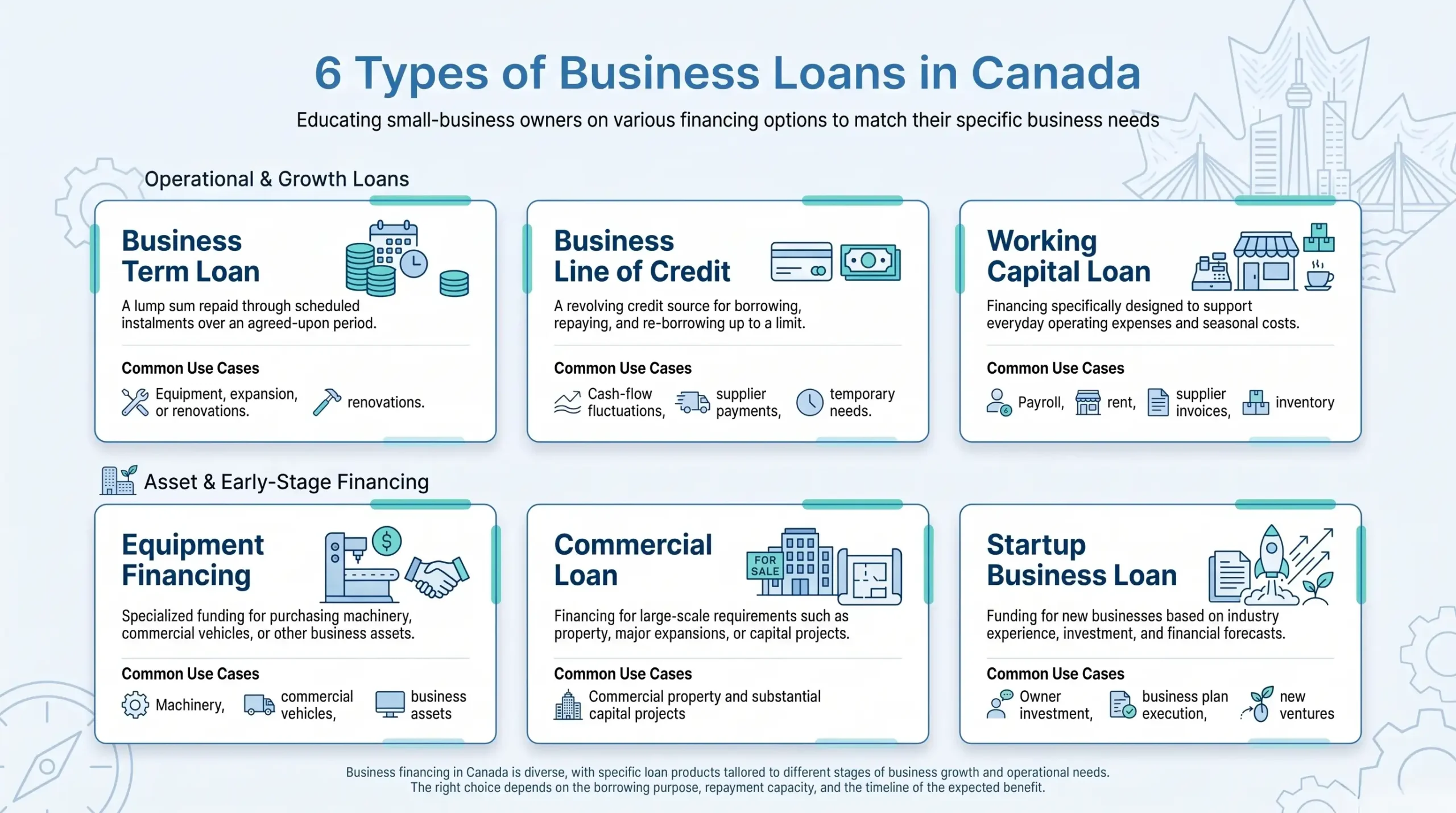
Choosing the right type of financing starts with matching the loan structure to the purpose of the money.
-
Business Term Loans
A term loan generally provides a lump sum that is repaid through scheduled instalments over an agreed period.
Term financing may be suitable for equipment, renovations, expansion or another significant planned investment where the cost and financing requirement are known in advance.
-
Business Lines of Credit
A business line of credit provides revolving access to funds up to an approved limit. Businesses can draw money when needed, repay it and potentially borrow again.
It can be useful for short-term cash-flow fluctuations, supplier payments or temporary working-capital requirements.
-
Working Capital Loans
Working capital financing can help cover routine business costs such as:
- Payroll
- Rent
- Supplier invoices
- Inventory
- Seasonal operating expenses
It should normally be used with a clear repayment strategy rather than as a permanent solution to ongoing operating losses.
-
Equipment Financing
Equipment financing is designed for machinery, commercial vehicles or other business assets. Depending on the arrangement, the purchased asset may help secure the financing.
-
Commercial Loans
Commercial loans may finance larger projects such as commercial real estate, major expansions or other substantial capital investments.
-
Startup Business Loans
Startups have less operating history for lenders to evaluate. As a result, factors such as the owner’s personal credit, industry experience, business plan, financial projections and personal investment may become particularly important.
Some financing products also require businesses to have operated for a minimum period.
-
Government-Supported Small Business Financing
The Canada Small Business Financing Program (CSBFP) helps improve access to financing by sharing lending risk with participating financial institutions.
Eligible businesses and start-ups operating in Canada with gross annual revenues of $10 million or less may qualify under the program. Current federal program limits allow up to $1.15 million per borrower, including up to $1 million in term loans and up to $150,000 through a line of credit, subject to program requirements and lender approval.
Business Loan Requirements in Canada
There is no single checklist that guarantees approval. Requirements vary by lender, loan size and financing product.
What Do Lenders Look At?
Common considerations include:
- Business revenue
- Profitability
- Cash flow
- Existing debts
- Time in business
- Personal credit
- Business credit history
- Owner investment
- Available collateral
- Management experience
- Industry risk
- Purpose of financing
Financial statements and cash-flow projections can be particularly important because lenders want evidence that the business is financially capable of meeting the proposed payments. BDC also identifies financial statements, financial projections and a solid business plan as important parts of preparing a loan application.
The 5 Cs of Business Credit
One useful way of understanding lender assessment is through the 5 Cs of credit.
- Character: The borrower’s repayment history, credibility, experience and credit behaviour.
- Capacity: Whether available income and cash flow can support current obligations plus the proposed loan.
- Capital: How much money the owner has personally invested in the business or project.
- Collateral: Assets that may provide additional security for the lender.
- Conditions: The purpose and terms of the financing as well as broader economic and industry circumstances.
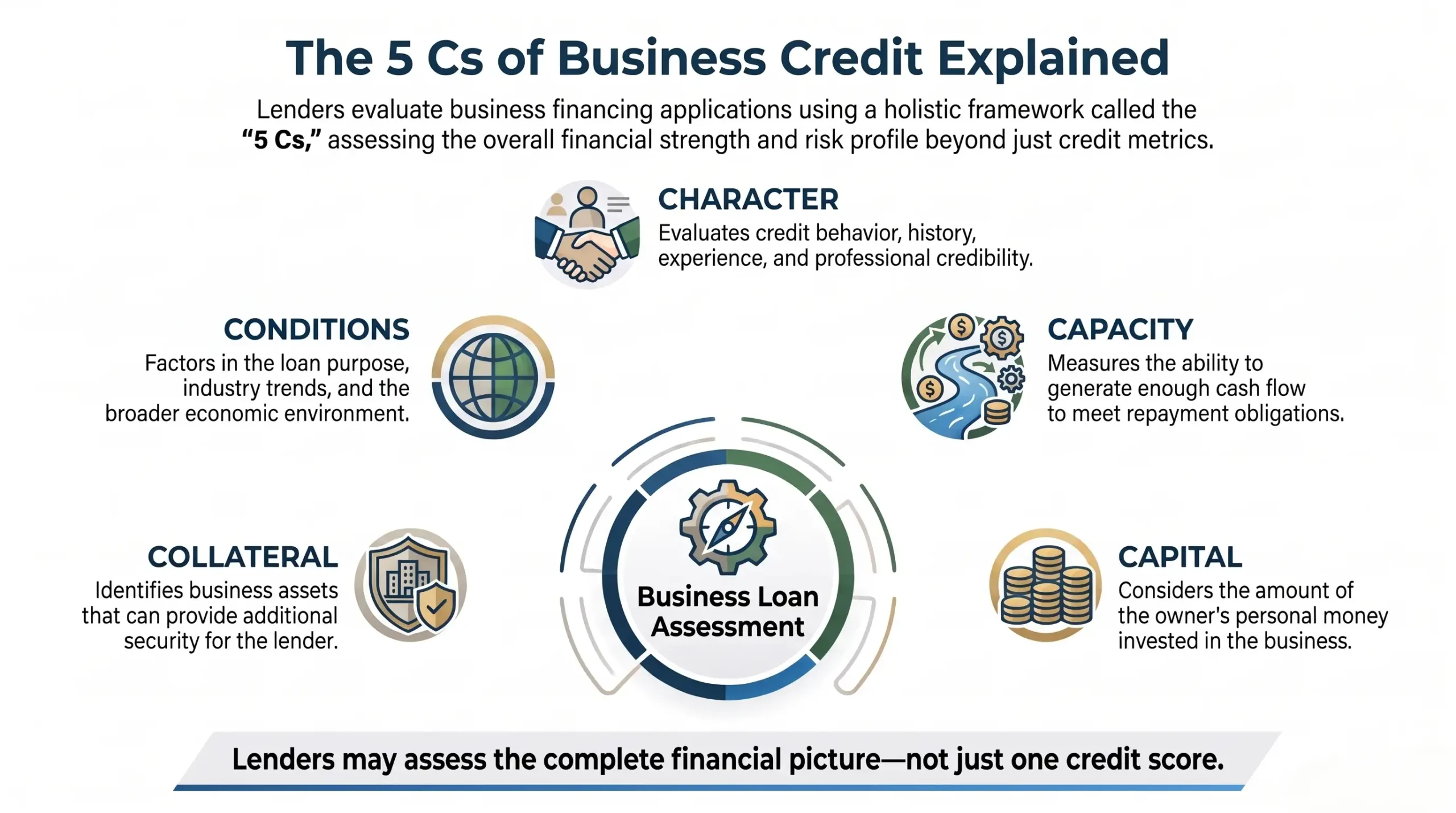
BDC uses these five categories when explaining how financial institutions may assess business borrowers, including applicants with weaker credit histories.
What Credit Score Do You Need for a Business Loan in Canada?
Is There a Minimum Credit Score for a Business Loan?
There is no universal minimum credit score for all business loans in Canada.
Different banks, credit unions and alternative lenders may establish their own lending criteria. Requirements can also change according to the amount requested, loan structure, collateral and overall risk profile.
A stronger credit profile can generally make it easier to access competitive financing, but credit is only one part of an application.
For example, BDC currently states that applicants are more likely to qualify for certain small-business loan products with a personal credit score of at least 600. That is a product-specific benchmark, not a Canada-wide business lending rule, and meeting it does not guarantee approval.
Personal Credit vs. Business Credit
Personal and business credit are separate financial profiles.
Personal credit can become particularly important for:
- Startups
- Sole proprietorships
- New businesses
- Personally guaranteed loans
- Smaller financing applications
An established company may also build a stronger standalone commercial credit history over time.
Canadian Personal Credit Score Range
Canadian consumer credit scores usually range from 300 to 900, with higher scores generally representing lower perceived credit risk. Your score can change as information in your credit history changes.
A lender may use the score alongside income, debts, repayment history and other underwriting information rather than treating it as the only approval factor.
Can You Get a Business Loan With Bad Credit?
Does Bad Credit Automatically Mean Rejection?
Not necessarily. Credit history matters, but lenders may also review the company’s financial performance, available cash flow, project strength, collateral and the owner’s overall financial position.
BDC notes that poor credit does not automatically eliminate the possibility of financing when other areas of an application are strong, although the final outcome always depends on the lender and circumstances.
What Lenders May Require When Credit Is Weak
Depending on the financing provider, a weaker credit profile could result in requirements such as:
- Stronger demonstrated cash flow
- Greater owner investment
- Additional collateral
- A personal guarantee
- More supporting documentation
- A smaller initial loan
- Higher borrowing costs
- Different repayment terms
These conditions are not universal, so borrowers should compare offers carefully.
Ways to Improve Your Position Before Applying
Before submitting a business loan application:
- Review your personal and business credit reports.
- Correct inaccurate information where appropriate.
- Bring overdue accounts current when financially possible.
- Reduce high revolving balances.
- Avoid unnecessary new credit applications.
- Organize financial statements and records.
- Prepare realistic cash-flow forecasts.
- Clearly document why the business needs financing.
If personal debt or credit issues are affecting your ability to pursue business financing, understanding the underlying financial situation first can help. Credit720 can help Canadians review their debt and credit position and understand practical next steps before taking on additional borrowing.
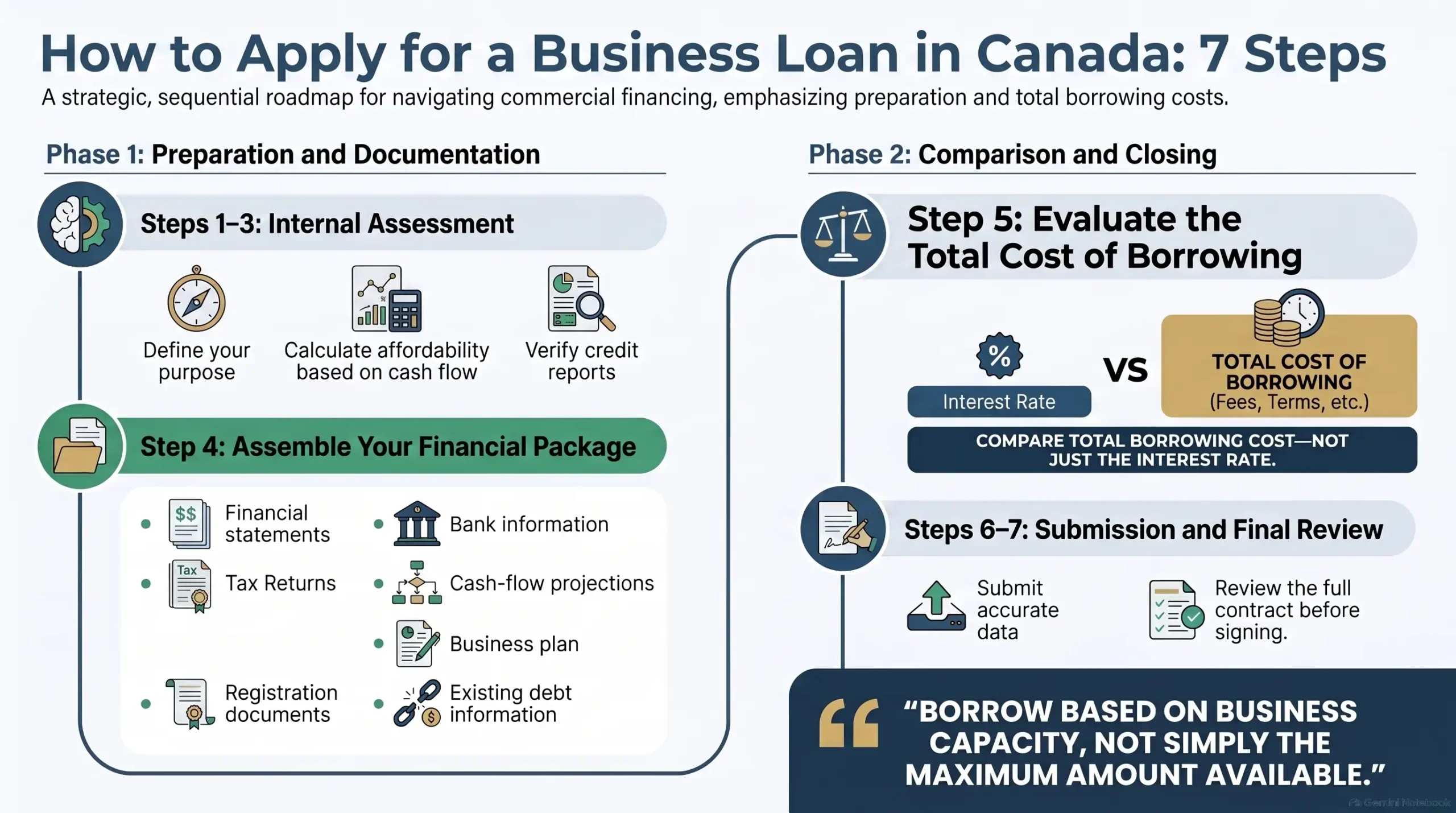
How to Apply for a Business Loan in Canada: Step-by-Step
Step 1 – Determine Why You Need Financing
Define the exact purpose of the loan, the amount required and how the financing is expected to benefit the business.
Borrowing $75,000 because a specific equipment purchase will improve production capacity is much clearer than borrowing because the company simply “needs more cash.”
Step 2 – Calculate How Much the Business Can Afford
Review:
- Current cash flow
- Existing loan payments
- Fixed operating expenses
- Expected future expenses
- Seasonal fluctuations
Consider what would happen if revenue temporarily declined while loan payments remained unchanged.
Step 3 – Review Personal and Business Credit
Check your credit before the lender does.
This gives you time to identify inaccuracies, understand potentially negative information and determine whether improving high credit balances before applying could strengthen your position.
Step 4 – Prepare Financial Documentation
Depending on the lender, required information may include:
- Financial statements
- Business bank statements
- Tax information
- Cash-flow forecasts
- Business registration documents
- A business plan
- Ownership details
- Existing debt information
- Quotes for equipment or assets being financed
Step 5 – Compare Financing Options
Look beyond the headline interest rate. Compare:
- Loan amount
- Interest rate
- Fees
- Repayment term
- Security requirements
- Personal guarantees
- Prepayment conditions
- Total borrowing cost
Step 6 – Submit the Application
Provide accurate and complete information. Missing or inconsistent records can delay the underwriting process.
Step 7 – Review the Offer Before Signing
Make sure you understand the full contract.
A lower monthly payment is not automatically a better deal if achieving that payment requires a significantly longer term and substantially more interest.
How Much Business Loan Can You Qualify For?
Why Revenue Alone Does Not Determine Borrowing Capacity
Business revenue is important, but sales alone do not show whether a company can afford additional debt.
Lenders may also consider:
- Profit margins
- Free cash flow
- Existing borrowing
- Debt-service obligations
- Business stability
- Collateral
- Loan purpose
Debt-Service Capacity
In simple terms, lenders want evidence that the business generates enough cash to meet current commitments and make the proposed new loan payments.
Consider two companies. One produces $500,000 in annual revenue but has narrow margins and substantial existing debt. Another has lower sales but consistently generates healthy, predictable cash flow. Revenue alone does not necessarily mean the first company has greater borrowing capacity.
Business Loan Interest Rates and Costs
What Determines Your Business Loan Rate?
Business financing rates can be affected by:
- Credit profile
- Business history
- Loan type
- Collateral
- Amount borrowed
- Loan term
- Cash flow
- Prevailing economic conditions
- Individual lender policies
Fixed vs. Variable Rates
A fixed rate generally remains unchanged for the agreed fixed-rate period, making payments easier to anticipate.
A variable rate can change as the lender’s reference rate changes, meaning borrowing costs may rise or fall.
Costs Beyond the Interest Rate
Potential borrowing costs may include:
- Setup or origination fees
- Administration charges
- Legal fees
- Appraisal expenses
- Registration costs
- Prepayment charges
Always compare the total cost of borrowing, not only the advertised rate.
For CSBFP financing, the federal program currently has a 2% registration fee. Its maximum interest-rate formulas also vary between term loans and lines of credit.
Business Loans vs. Other Financing Options
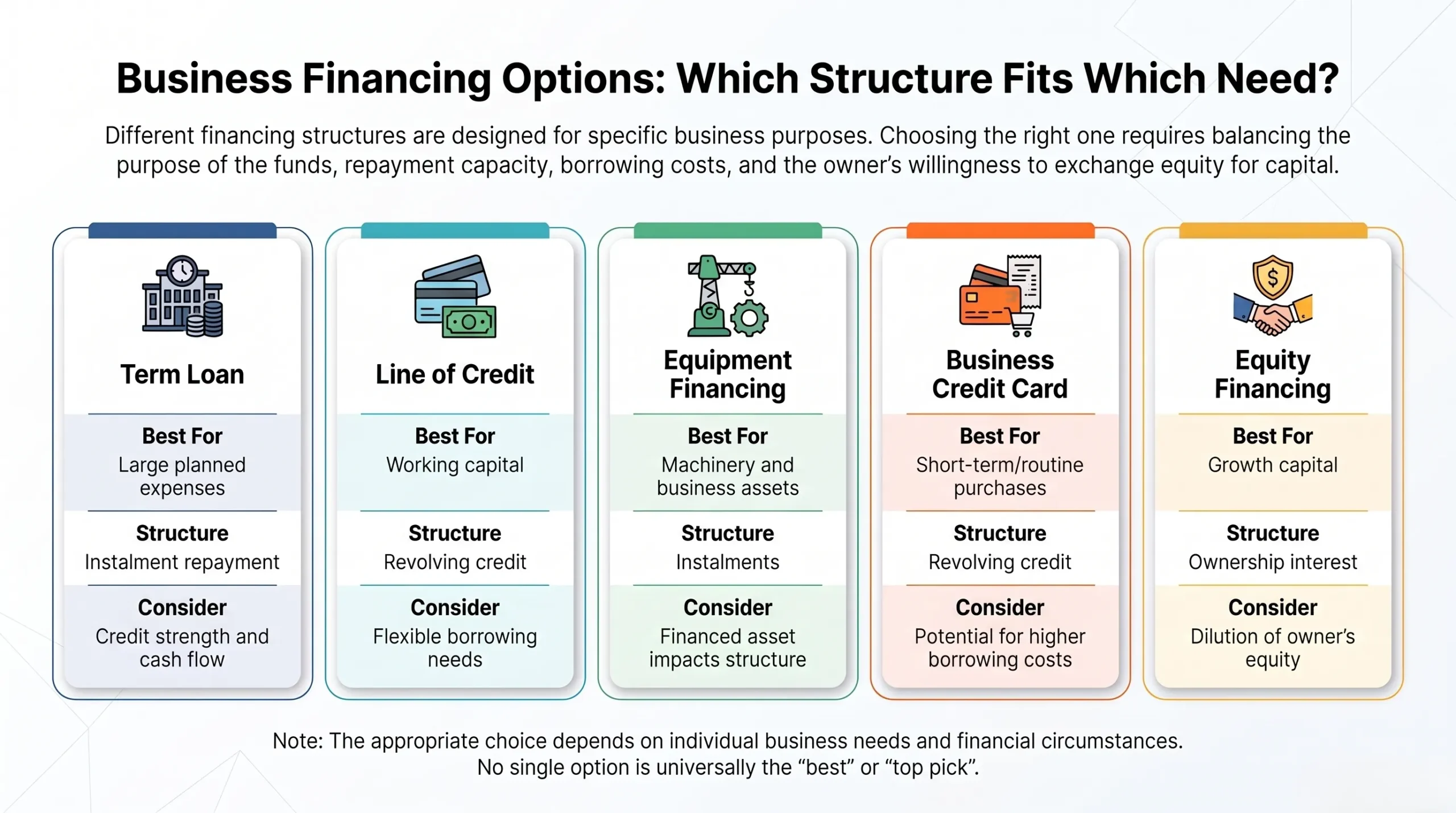
Different financing tools are suited to different business needs.
|
Financing Option |
Best Suited For | Repayment Structure | Typical Consideration |
| Term loan | Large planned expense | Instalments | Credit and cash flow |
| Line of credit | Working capital | Revolving | Flexible access |
| Equipment financing | Machinery or assets | Instalments | Asset-related financing |
| Business credit card | Short-term purchases | Revolving | Potentially higher cost |
| Equity financing | Growth capital | No traditional loan repayment |
Ownership dilution |
-
Business Loan vs. Line of Credit
A term loan is often better suited to a defined one-time expense, while a line of credit may provide greater flexibility for recurring short-term liquidity needs.
-
Business Loan vs. Business Credit Card
Business credit cards can be convenient for day-to-day purchases but may become expensive if large balances remain unpaid.
-
Business Loan vs. Equipment Financing
Equipment financing directly connects borrowing to an asset purchase and may allow that asset to form part of the lender’s security.
-
Business Loan vs. Personal Loan
Using personal loans for business expenses can blur the separation between personal and commercial finances and increase the owner’s personal financial exposure.
-
Business Loan vs. Equity Financing
Debt financing allows owners to retain ownership but creates repayment obligations. Equity financing generally does not involve scheduled loan repayments, but the business gives investors an ownership stake in return for their capital.
Government-Supported Business Financing in Canada
Canada Small Business Financing Program
The Canada Small Business Financing Program is intended to make financing more accessible by sharing risk with participating lenders.
The program is delivered through financial institutions rather than directly providing borrowers with federal loans. Eligible businesses and startups generally need to operate in Canada and have gross annual revenues of $10 million or less.
Government Program Does Not Mean Guaranteed Approval
Government support should not be confused with automatic approval.
The financial institution still evaluates the borrower and makes the credit decision. Eligibility for a government-supported program therefore does not mean every applicant will receive financing.
Common Business Loan Mistakes to Avoid
1. Borrowing Without a Clear Purpose
Debt should solve a clearly identified financing need. Borrowing without knowing how the money will support or generate cash flow can create unnecessary financial pressure.
2. Applying Without Checking Credit
Finding credit-report issues after submitting an application leaves little time to address them.
3. Borrowing More Than Cash Flow Can Support
Approval for a particular amount does not necessarily mean borrowing the maximum amount is financially sensible.
4. Comparing Only Interest Rates
Fees, repayment periods and other conditions can materially affect the total cost.
5. Applying to Multiple Lenders Without a Strategy
Repeated credit applications may complicate the process, particularly where personal credit checks are involved.
6. Mixing Personal and Business Finances
Keeping records and accounts separate generally creates a clearer financial picture.
7. Ignoring Existing Personal Debt
Large credit-card balances, personal loans or other obligations may affect the owner’s overall borrowing position.
8. Using Short-Term Financing for Long-Term Assets
Where possible, match the financing term with the useful life and purpose of the asset instead of repeatedly refinancing a long-term investment with expensive short-term debt.
Business Loan Myths vs. Facts
Myth: You need perfect credit to get a business loan.
Fact: Credit matters, but lenders may also assess business performance, cash flow, collateral, project viability and management experience.
Myth: The business with the highest revenue qualifies for the biggest loan.
Fact: Profitability and repayment capacity matter along with revenue.
Myth: Government-supported loans are automatically approved.
Fact: Participating financial institutions still make lending decisions.
Myth: Personal credit never affects business borrowing.
Fact: It may be especially relevant for startups, young businesses and personally guaranteed financing.
Myth: The lowest monthly payment means the cheapest loan.
Fact: Extending the repayment period can lower monthly payments while potentially increasing total interest paid.
Expert Tips to Improve Your Chances of Business Loan Approval
Strengthening the business before applying can improve the quality of the application.
Consider these steps:
- Keep accurate financial records.
- Separate personal and business finances.
- Monitor personal and commercial credit.
- Pay financial obligations on time.
- Reduce unnecessary debt.
- Maintain adequate cash reserves.
- Prepare realistic revenue and cash-flow forecasts.
- Explain exactly how the financing will generate or protect cash flow.
- Avoid waiting until the business reaches a severe cash-flow crisis.
- Compare terms strategically before applying for multiple loans.
- Understand any personal guarantee.
- Address significant personal debt before relying on more borrowing.
Think like a lender: The core question is not simply whether your business needs money. The lender wants evidence that the business can repay the money under the proposed terms.
When a Business Loan May Not Be the Right Solution
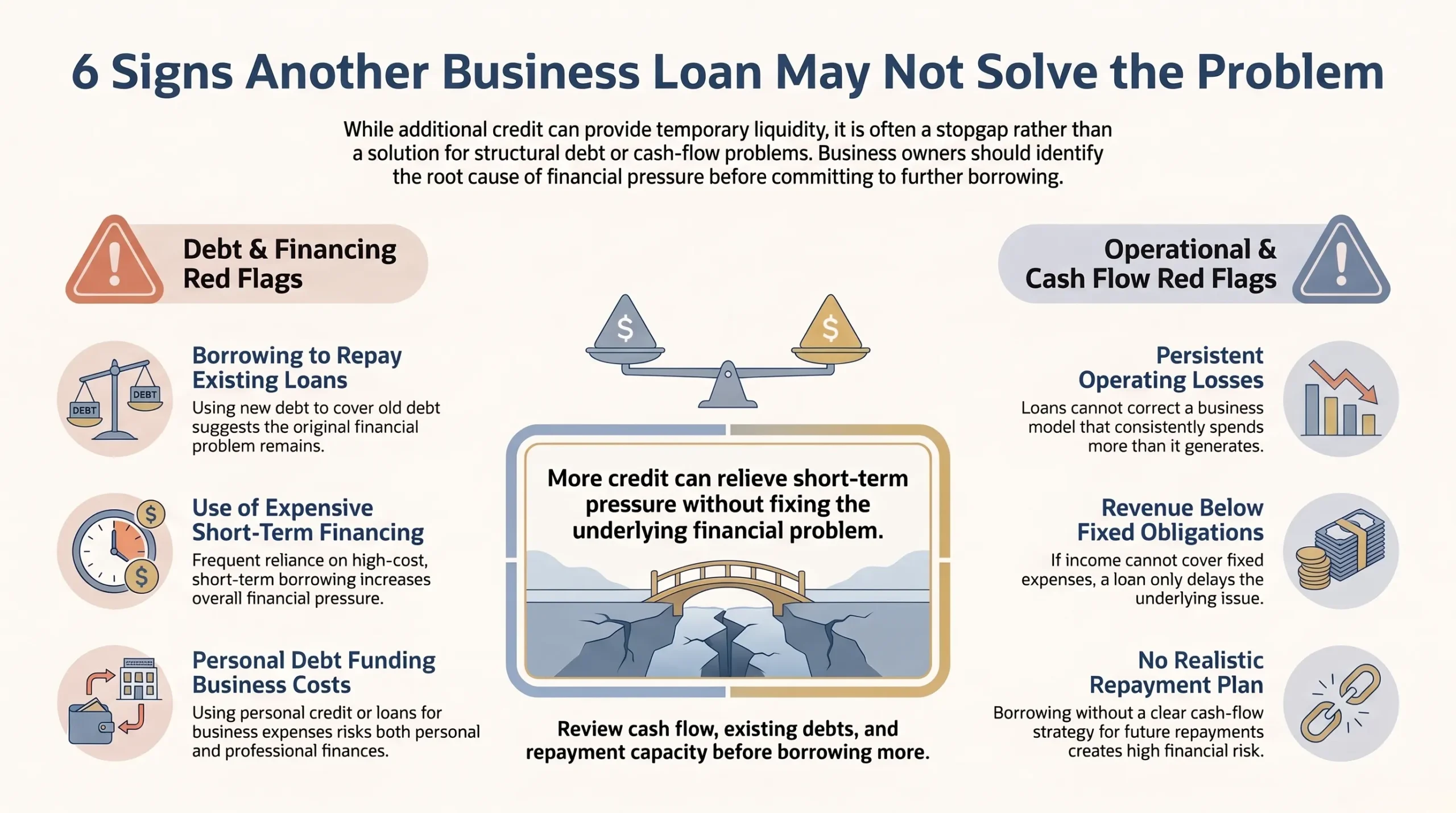
Warning Signs
Additional borrowing deserves careful consideration if the business is:
- Taking new loans to make payments on existing loans
- Experiencing persistent operating losses
- Repeatedly relying on expensive short-term credit
- Borrowing without a realistic repayment plan
- Using significant personal debt to fund regular business expenses
- Generating revenue consistently below fixed financial obligations
Consider the Underlying Financial Problem
New credit can temporarily relieve a cash-flow problem without correcting its underlying cause.
For example, borrowing to cover three months of expenses may provide breathing room during a predictable seasonal slowdown. Continually borrowing to fund permanent operating losses is a different situation.
Before taking on another obligation, business owners dealing with substantial personal debt or credit pressure may benefit from reviewing the entire financial picture. Credit720 provides debt and credit guidance that can help Canadians better understand their current position and available options.
Practical Example: Choosing the Right Financing Strategy
Consider a Toronto business owner who has operated for three years and needs $75,000 to purchase equipment and increase inventory.
The business has stable revenue, but the owner also carries significant personal credit-card balances and has a fair rather than excellent credit profile.
Instead of immediately applying for one $75,000 general-purpose loan, the owner could:
- Separate the equipment cost from working-capital needs.
- Calculate affordable monthly repayment capacity.
- Review personal and business credit reports.
- Determine whether reducing personal credit balances would strengthen the application.
- Prepare financial statements and cash-flow forecasts.
- Compare equipment financing, a term loan and a line of credit.
- Calculate the total cost of each option.
- Avoid assuming stable revenue alone guarantees approval.
This approach turns borrowing into a financial planning decision rather than simply a search for available credit.
FAQs
What is a business loan?
A business loan is financing borrowed for eligible commercial purposes such as equipment, inventory, working capital or expansion. The business generally repays the principal plus interest under terms agreed with the lender.
What credit score is required for a business loan in Canada?
There is no universal credit-score requirement for every Canadian business loan. Minimum criteria differ among lenders and financing products. Stronger credit can generally improve financing options, but cash flow, business history, debt, collateral and other factors can also affect approval.
Can I get a business loan with bad credit?
Potentially. A weaker credit history does not automatically prevent all business financing. Lenders may also examine business performance, cash flow, collateral, owner investment and other financial factors. Rates and conditions may differ where credit risk is higher.
Do lenders check personal credit for business loans?
Many lenders may review personal credit, particularly when financing a startup, small business or personally guaranteed loan. The extent to which personal credit affects the application varies by lender and financing product.
What documents are normally required for a business loan?
A lender may request financial statements, business bank information, tax records, business registration documents, a business plan, cash-flow projections, ownership information, existing debt details and quotes or supporting documents for assets being purchased.
Can a startup qualify for a business loan in Canada?
Yes, startup financing options exist, but newer businesses may face greater scrutiny because they have limited operating history. The owner’s personal credit, experience, investment, financial projections and business plan may therefore carry greater weight.
How much can I borrow through a business loan?
There is no universal revenue multiple that determines borrowing capacity. Available financing can depend on profitability, cash flow, existing debt, credit history, collateral, financing purpose and individual lender policies.
Will applying for a business loan affect my personal credit?
It depends on the lender and application structure. If the lender performs a personal hard credit inquiry, the application may affect your personal credit file. Before applying, ask whether personal credit will be checked and what type of inquiry will be performed.
Conclusion
The right business loan is not necessarily the largest amount a lender is willing to provide. The purpose of the financing, repayment capacity, credit strength, loan structure and total borrowing cost all deserve consideration before signing an agreement.
Business owners should also look beyond the company itself. When significant personal debt or credit challenges exist, adding another financial obligation may not address the underlying problem.
Reviewing your credit, organizing financial records and comparing financing options carefully can lead to better-informed borrowing decisions. If debt or credit concerns are making that process more difficult, Credit720 can help you explore your financial position, understand available debt solutions and determine practical next steps before taking on additional credit.