



Your mortgage payments are up to date, but credit card balances barely seem to move. An unexpected repair or reduced work hours can make things harder, even when you own a home that has increased in value.
This is why some Canadians explore equity loans. Borrowing against a property may help cover necessary expenses or reorganize expensive debt, but the decision involves more than finding a smaller monthly payment.
Your home becomes security for the borrowing. That makes it essential to understand repayment obligations, fees, and what could happen if your income changes.
Comparing Equity loan Services also means looking beyond approval. You need to know whether the arrangement fits your budget, protects your long-term financial stability, and addresses the reason debt accumulated.
This guide explains how home equity borrowing works in Canada, what lenders assess, and how it can affect your credit. These products generally require property ownership; Canadians without a home can explore unsecured borrowing, credit counselling, and other debt solutions instead.
What Is a Home Equity Loan?
Understanding Home Equity and Secured Borrowing
A home equity loan provides a lump sum secured against your property. Home equity is the property’s appraised value minus outstanding mortgages and other debts secured against it.
Three terms help explain the arrangement:
- Collateral: The property securing repayment.
- Principal: The amount borrowed and still owed.
- Interest: The lender’s charge for borrowing.
Accessing equity creates debt; it does not turn your property’s value into free money.
How Home Equity Loan Repayments Work
A standard amortizing equity loan has scheduled payments covering principal and interest. The term is the contract’s duration; amortization is the estimated period needed to repay the loan fully.
A loan can therefore have a short term but a longer repayment schedule, leaving a balance requiring repayment or renewal when the term ends. Rates may be fixed or variable.
Home Equity Loan vs HELOC vs Mortgage Refinancing
Lump-Sum Loans Compared With Revolving Credit
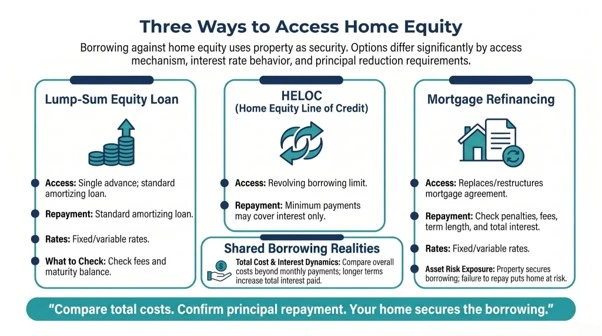
A lump-sum loan suits a defined borrowing amount. A home equity line of credit, or HELOC, allows repeated withdrawals and repayments within an approved limit.
HELOC interest applies to the amount drawn, and rates are generally variable. An interest-only minimum payment leaves the principal unchanged.
A second mortgage describes financing ranked behind an existing mortgage on the same property. It can fund a lump-sum equity loan, while payments on the first mortgage continue.
Refinancing and Other Ways to Access Equity
Refinancing replaces or restructures your existing mortgage and may release additional funds. Review changes to the rate, term and repayment period, alongside potential mortgage-breaking costs.
| Product | Access to funds | Repayment consideration |
| Lump-sum equity loan or second mortgage | One advance | Scheduled payments, fees and remaining balance at maturity |
| HELOC | Reusable approved credit | Variable-rate exposure and deliberate principal repayment |
| Mortgage refinancing | Funds released through a revised mortgage | Changes to the whole mortgage and potential penalties |
Other options include readvanceable mortgages, permitted reborrowing of mortgage prepayments, and reverse mortgages for eligible older homeowners. Each deserves a separate suitability review because access and repayment conditions differ.
How Much Can You Borrow Against Your Home?
Available Equity and Loan-to-Value Limits
Combined loan-to-value, or LTV, measures total property-secured debt against appraised value. Conventional equity borrowing commonly has an 80% combined ceiling, subject to qualification; your existing mortgage uses part of that limit.
The revolving HELOC component generally has a 65% limit at federally regulated lenders. Combined mortgage-and-HELOC arrangements may reach 80%, but borrowing above 65% must follow amortizing, non-revolving requirements.
Practical Example of Potential Borrowing Capacity
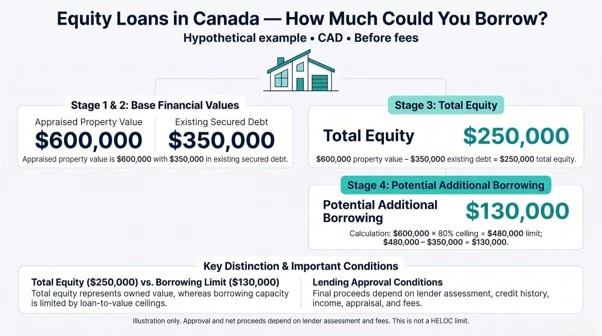
Hypothetical example, before fees:
| Calculation | Amount |
| Appraised property value | $600,000 |
| Existing secured debt | $350,000 |
| Total equity | $250,000 |
| Assumed combined ceiling at 80% | $480,000 |
| Potential additional borrowing | $130,000 |
The $250,000 equity figure is not the amount available to withdraw. The $130,000 estimate remains subject to lender assessment, and fees can reduce net proceeds; it does not establish a HELOC entitlement.
Can You Get a Home Equity Loan With Bad Credit?
What Lenders Consider Besides Your Credit Score
Some homeowners may qualify despite credit problems, but property ownership alone does not guarantee approval. Lenders assess factors such as:
- Ownership, appraised value, and existing registered claims or liens.
- Verified income, employment history, and self-employment records.
- Housing expenses, other debt payments, and repayment capacity.
Self-employed applicants may need tax returns, Notices of Assessment, and business documentation. Requirements vary by lender.
Banks require a stress test for HELOC qualification and mortgage refinancing. It assesses affordability at a qualifying rate above the actual contract rate.
How Credit History and Lender Type Affect Your Options
Missed payments, collections, high balances, and previous insolvency can affect the decision. There is no single minimum credit score applying to every Canadian lender.
Banks and credit unions have their own criteria. Alternative or private lenders may offer different options, but flexibility can involve higher rates, fees, short terms, or interest-only payments. Understand the maturity balance and renewal conditions before committing.
If you are in an active consumer proposal or bankruptcy, speak with the responsible Licensed Insolvency Trustee before pursuing secured borrowing. Ask whether any preliminary assessment requires a hard credit inquiry.
What Are the Interest Rates and Costs?
Understanding Rates and Total Repayment Cost
Equity loan rates in Canada depend on the lender, product, and application. A fixed rate stays unchanged during its agreed term; a variable rate can change.
Compare offers over the same repayment period. Extending repayment may lower monthly payments while increasing total interest.
Ask for a second payment illustration using a higher rate. For short-term financing, also ask what you would owe if renewal were unavailable.
Fees, Penalties and Tax Considerations
Potential costs include appraisal, legal or notary, title, lender, and broker fees. Check early repayment restrictions, discharge charges, and any refinancing penalty.
Distinguish costs paid upfront, deducted from funding, or added to the loan. Hypothetically, a $40,000 advance with $2,000 withheld in fees leaves $38,000 available, despite a $40,000 starting principal.
Interest is not automatically tax-deductible because your home secures the loan. How borrowed funds are used and applicable tax rules matter; obtain tax advice for income-producing uses.
Request written figures for payments, fees, net proceeds, and the maturity balance.
How Do Home Equity Loans Affect Your Credit Score?
Credit Checks and New Account Reporting
A lender’s hard inquiry can affect your credit score. Checking your own credit report does not.
Ask whether the lender reports the account and repayment history to Equifax, TransUnion, or both. Credit outcomes depend on your existing profile, reporting, and the scoring model; extra debt can also affect borrowing affordability independently of your score.
Potential Credit Improvement After Consolidation
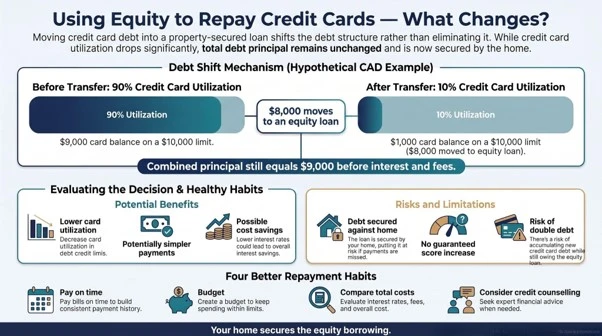
Paying down credit cards can reduce utilization: the percentage of available credit you use. For example:
- A $9,000 balance on a $10,000 card limit means 90% utilization.
- Reducing it to $1,000 means 10% utilization on that card.
- The equity loan used to repay the card remains outstanding.
Lower utilization and consistent on-time payments may support credit improvement, but no particular increase or timeline is guaranteed. FCAC recommends keeping credit use below 30% of your total limit.
Consolidation transfers debt rather than eliminating it. A new loan also does not erase accurate negative credit history.
Should You Use Home Equity for Debt Consolidation?
Potential Benefits and Risks
Home Equity Debt Consolidation may simplify payments and reduce costs when the complete comparison supports it. However, unsecured credit card debt is replaced by borrowing secured against your home.
That reduces your equity and makes income disruption more consequential. Falling property values may further limit future borrowing or selling options; failing to repay secured obligations can put your home at risk.
For example, consolidating a repair-related balance might help a household with a stable budget. Repeatedly borrowing to cover a monthly shortfall leaves the underlying problem unresolved, especially if card balances build again.
Alternatives Worth Comparing
Compare unsecured consolidation, spending adjustments, credit counselling, and debt management plans. A debt management plan generally aims to repay participating debts in full, sometimes with reduced interest, rather than providing debt forgiveness.
Credit720 can help you review your budget and debt repayment options before deciding whether more borrowing is appropriate. For unmanageable debt, seek an insolvency assessment; consumer proposals and bankruptcies are administered by Licensed Insolvency Trustees.
How to Prepare for an Equity Loan Application
Step-by-Step Application Preparation
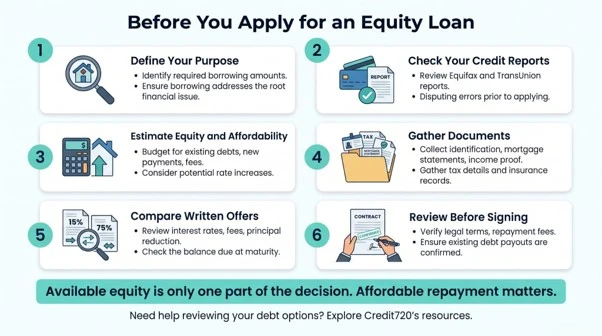
- Define the purpose. Identify the amount needed and whether borrowing addresses the cause of the debt.
- Review both credit reports. Check Equifax and TransUnion records and dispute errors before applying.
- Estimate equity and affordability. Include household expenses, existing payments and room for unexpected costs.
- Gather documents. Prepare identification, mortgage statements, income records, property tax details and insurance information.
- Compare written offers. Review rates, fees, net proceeds, repayment conditions and maturity obligations.
- Complete lender and legal requirements. Review the appraisal, property security registration and funding arrangements before signing.
Questions to Ask Before Signing
- Is the offer conditional, and what remains outstanding?
- Does each payment reduce principal?
- What balance is due at maturity if renewal is declined?
- Which early repayment fees apply?
- What provincial licence or registration applies to the provider?
Also confirm how existing creditors will receive their payouts. Continue required payments until the payouts are confirmed, and retain confirmation that each intended balance was cleared.
Equity Loan Myths and Common Mistakes
Myth vs Fact
| Myth | Fact |
| Owning a home guarantees approval | Equity is only part of the assessment. |
| Lower payments always mean savings | Fees and longer repayment can increase total costs. |
| An equity loan immediately repairs bad credit | Outcomes depend on reporting and repayment behaviour. |
Common Borrowing Mistakes
Avoid borrowing the maximum simply because it is available. Other mistakes include overlooking fees, treating interest-only payments as debt reduction, ignoring maturity obligations and rebuilding card balances after consolidation.
Be cautious about guaranteed approval or instant credit repair claims. Build a repayment plan that works without rising property prices or assumed future refinancing approval.
FAQs
What credit score do I need for a home equity loan in Canada?
There is no universal minimum. Each lender sets its requirements and considers credit history, income, existing obligations, and property equity. A lower score may limit your options or result in more expensive terms.
Can I get an equity loan if I already have a mortgage?
Potentially. Your existing mortgage and other property-secured debts reduce the additional borrowing available. A lender must assess the property’s value, the proposed combined borrowing, and your ability to manage the payments.
How is a home equity loan different from a HELOC?
A home equity loan provides one lump sum with an agreed repayment schedule. A HELOC offers revolving access within a limit, usually at a variable rate. Interest-only HELOC payments do not reduce the borrowed principal.
Will paying off credit cards with home equity improve my credit score?
It may help by lowering card utilization, but improvement is not guaranteed. New borrowing, credit checks, and repayment behaviour also matter. You still owe the transferred debt and must avoid rebuilding the card balances.
Can self-employed Canadians qualify for equity borrowing?
Yes, subject to lender assessment. Expect requests for income evidence such as tax returns, Notices of Assessment and business records. Available equity does not remove the need to evaluate whether repayment is affordable.
What happens if I cannot repay my home equity loan?
Contact the lender promptly and seek professional guidance. Depending on the agreement and provincial law, default can lead to enforcement against your property, including a sale. Acting early gives you more time to assess options.
How long does approval and funding take?
Timing varies by lender and application. Income verification, appraisal, title issues, and legal registration can affect funding. Ask for a conditional timeline and avoid relying on the money until all funding requirements are satisfied.
Conclusion
Equity loans can support a planned expense or debt repayment strategy, but the right decision starts with affordability. Compare the product, full borrowing costs, and repayment obligations rather than focusing only on approval or a lower monthly payment.
Remember that using home equity does not erase debt or guarantee better credit. Sustainable progress depends on manageable payments, accurate credit reports, and a budget that prevents balances from growing again.
Before securing additional debt against your home, consider alternatives and leave room for financial setbacks. If you are unsure where to begin, explore Credit720’s debt resources or seek credit counselling to understand your options and build a realistic repayment plan.